
Views: 0 Author: Site Editor Publish Time: 2026-11-23 Origin: Site


The industry counts five main types. These are gravity, pressure, vacuum, piston, and pump fillers, plus hybrid variants. Each type works on a different filling principle.
Professionals use the terms liquid packing machine and liquid filler interchangeably. Both describe equipment that measures and dispenses a product into containers. The five types differ in how they move that product.
Buyers compare liquid fillers on speed, accuracy, suitable liquids, regulatory compliance, and cost. These five factors guide every equipment decision. A clear view of each type helps buyers match a machine to the job.
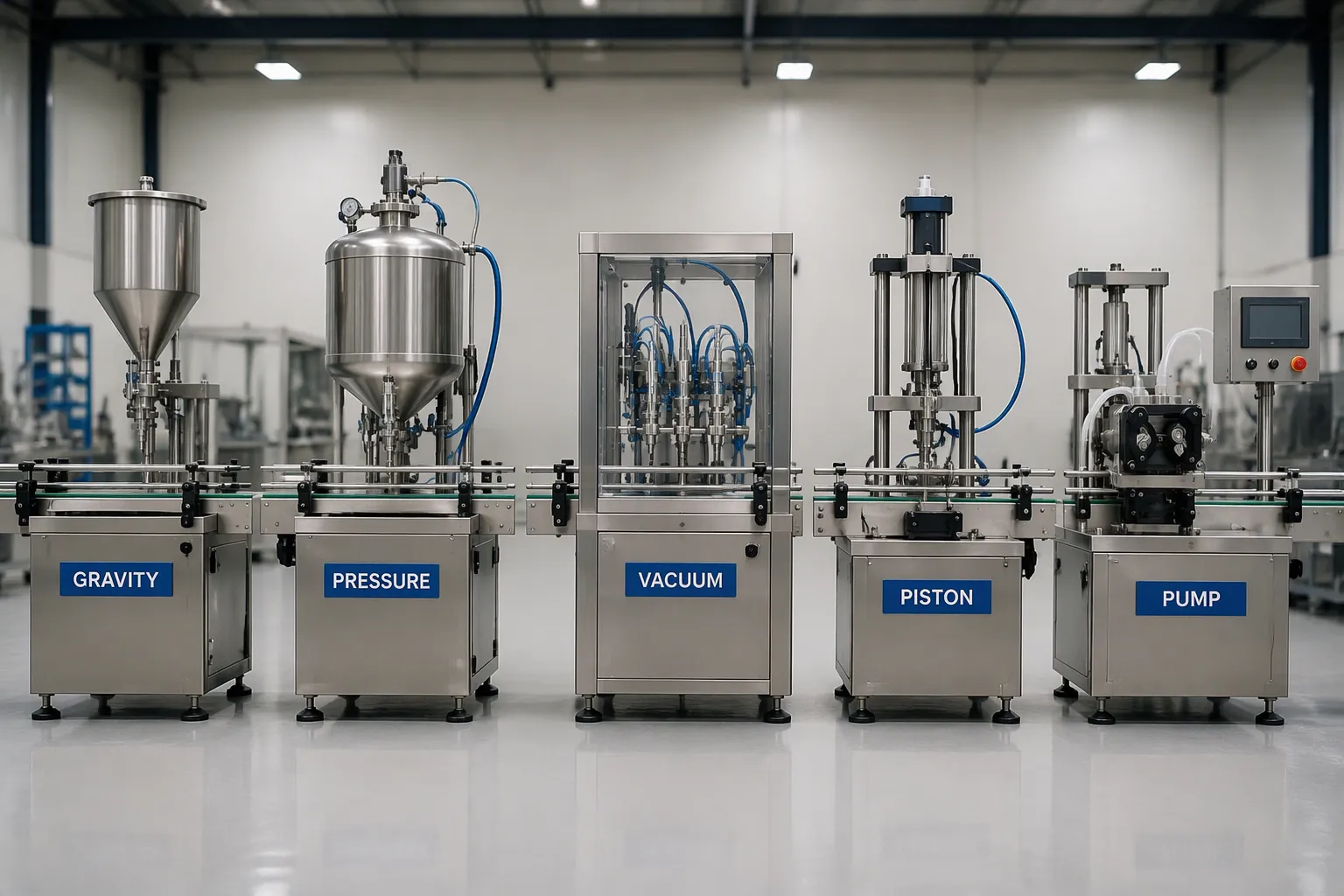
The industry groups liquid filling machines into five main types by how they fill: gravity, pressure, vacuum, piston, and pump. Every production filler is built on one of these principles. The principle decides how the machine moves liquid products into containers.
Hybrid and special variants mix or adapt these five principles. They are not separate categories. A net-weight filler still uses a pump or gravity feed underneath. An overflow filler adapts gravity or pressure. The count stays at five.
This matters for buyers. A liquid packing machine catalog may list dozens of models. Each model traces back to one core principle. Knowing the principle tells you more than the model name.
The table below gives a neutral overview. Exact figures vary by model and product, so treat the ranges as general guidance.
Filler Type | Typical Speed | Filling Accuracy | Suitable Viscosity | Relative Cost |
|---|---|---|---|---|
Gravity | Moderate to high | Good for thin liquids | Low | Low |
Pressure | High | Good, level-based | Low to medium | Moderate |
Vacuum | Moderate | Consistent fill levels | Low to medium | Moderate |
Piston | Moderate | High volumetric accuracy | Medium to high | Moderate to high |
Pump | Varies by pump design | Good to high | Wide range | Moderate to high |
Each type fits a different job. Gravity fillers suit water-thin products and simple bottles. Pressure fillers suit high-speed lines. Vacuum fillers suit foamy products. Piston fillers suit thick sauces and creams. Pump fillers cover the widest viscosity span.
Liquid filling machines also differ from the broader family of packaging machines. Form fill seal units, pouch machines, aseptic systems, and bottle filling and capping lines all handle more than filling. A filler is one station inside that larger line.
Automation levels form a separate classification axis. Manual, semi-automatic, inline, and monobloc configurations describe how a machine is deployed. They are not additional filling types. Any of the five fillers can run at any automation level.
The same logic applies across packaging machinery. A capper, labeler, or sealer is a line component, not a filler type. Buyers who separate filling principle from line role and automation level make cleaner comparisons. The five-type count holds across every configuration.
A liquid packing machine seldom runs by itself. It takes one spot in a full line. Cappers close the bottles. Sealers keep the contents fresh. Labelers add the brand name. Conveyors tie all the stations together.
This setup clears up a common mix-up. People often confuse liquid packaging machines with the larger group of packaging machines. The two overlap, but they are not the same. A filler measures and dispenses the product. A form fill seal unit, pouch machine, or aseptic system also handles forming, sealing, or sterilization.
The industry sorts equipment by its main packaging job. That sorting by main packaging job puts fillers in one group and cappers, sealers, and labelers in others. Buyers who get this split can compare quotes more accurately. They can see which station does the real filling work.
Automation level is a different question from filler type. Manual, semi-automatic, inline, and monobloc setups tell how a machine runs. They do not tell how it fills.
Manual units fit small batches and tight budgets.
Semi-automatic units add powered dosing, and the operator loads the product.
Inline units run nonstop inside a conveyor line.
Monobloc units put filling, capping, and sealing on one frame.
Any of the five fillers can run at any of these levels. A piston filler may be manual or monobloc. A gravity filler may be semi-automatic or inline. Automation changes output and staffing needs, not the filling principle.
This difference matters across packaging machinery. The same logic holds for every kind of packaging machine on the floor. A capper is a line part, not a filler. A labeler is a line part, not a filler. The five-type count stays firm.
Types of packaging machines grow fast in any catalog. Types of packaging machines also differ by role, not just by name. Keep the filling principle apart from the line role and the automation level. That habit keeps comparisons clean across all packaging machinery.
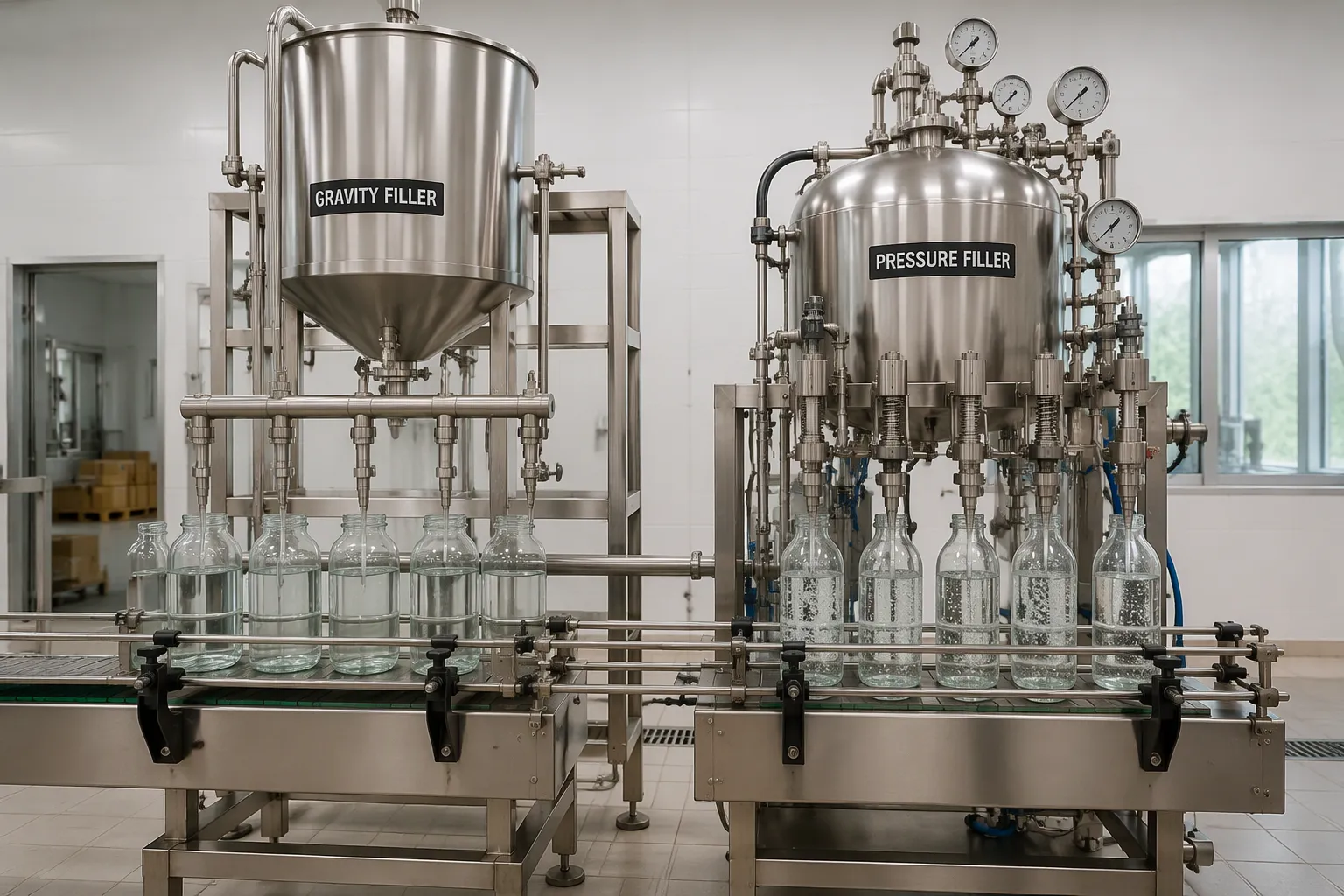
Gravity fillers use only gravity to work. A raised tank sends product down into containers below. A valve opens for a set time, and the liquid drops into place. These filling machines work well for water-thin liquids like juice, water, and vinegar. Thin liquids flow fast and level out by themselves.
Speed is moderate to high on setups with many nozzles. Accuracy stays good for thin products. Thick products clog the nozzles and slow the flow. Simple bottles and jars work best here. Wide-mouth containers fill quickly. Narrow necks take more time.
Meeting regulations stays simple. Gravity units have few moving parts and simple surfaces. They clean easily to meet food and beverage standards. The relative cost is low. These atmospheric pressure filling machines give small producers an affordable way to start.
Pressure filling machines push product with compressed air or a pressurized tank. The product moves faster than gravity alone allows. Nozzles release the flow under controlled pressure. These units are also called isobaric filling machines when they fill under counter-pressure. That design keeps carbonated drinks from foaming.
Speed runs high, which suits long production runs. Accuracy stays good because fill levels follow nozzle timing. Low to medium viscosity liquid products fit best. Glass bottles and rigid containers handle the pressure well. Thin plastics may need support.
Compliance needs careful attention. Pressurized systems need pressure-relief valves and regular inspection. Food and beverage rules apply to every wetted surface. The relative cost is moderate. These filling machines sit mid-range among packaging machines. Buyers who weigh packaging machinery options often pick pressure units for speed. The table below compares the two types.
Feature | Gravity Fillers | Pressure Fillers |
|---|---|---|
Drive method | Gravity feed | Compressed air or tank pressure |
Speed | Moderate to high | High |
Accuracy | Good for thin liquids | Good, level-based |
Viscosity fit | Low | Low to medium |
Relative cost | Low | Moderate |
Vacuum filling machines remove air from a sealed container. The vacuum pulls liquid up into the bottle. A tube goes to a set height, so each container stops at the same level. This method gives steady fill levels over a long run.
Foam control is the main benefit. Thin, foamy products like juices and detergents do not splash much under vacuum. The sealed chamber also limits contact with outside air. Speed is moderate, and accuracy stays reliable for low to medium viscosity products. Glass bottles and rigid plastic containers work best. Compliance work centers on clean seals and sanitary tubing. Sealed chambers need regular gasket checks to keep the vacuum. The relative cost is moderate.
Operators like the simple level control. They set one tube height, and the machine repeats it. Changeovers take little time on most models. Training needs stay low.
Piston filling uses a cylinder and a moving piston. Each stroke pushes out a set volume of product. That design gives high volumetric accuracy, even for thick products. A paste filling machine and a sauce filling machine both use this principle.
Speed is moderate, and accuracy is high. Medium to high viscosity products work best — creams, gels, and sauces. Wide-mouth jars and rigid containers work well. Cylinder size sets the dose, so one machine can run several volumes. Thick products move slowly, so cycle times run longer. Compliance needs sanitary seals and easy-clean cylinders. The relative cost is moderate to high.
Feature | Vacuum Fillers | Piston Fillers |
|---|---|---|
Drive method | Vacuum draw | Piston stroke |
Accuracy | Consistent levels | High accuracy (by volume) |
Viscosity fit | Low to medium | Medium to high |
Both types play clear roles in packaging machinery. A buyer comparing packaging machines should match the filling principle to the product first. Each filling machine earns its place on the line. Smart buyers treat packaging machinery as a system, not a single unit. That view helps them compare packaging machines with confidence.
Pump fillers use a powered pump to move the product. There are four main designs: gear, lobe, progressive cavity, and peristaltic. Each design works best with a certain kind of product. Gear pumps are good for thin oils and syrups. Lobe pumps move sauces with chunks without crushing the solids. Progressive cavity pumps handle thick pastes at a steady flow. Peristaltic pumps keep the product inside a tube, so it never touches the pump body.
Speed depends on the pump design and how many nozzles there are. Accuracy goes from good to high, and a set volume stays the same over a long run. These filling machines cover the widest range of thickness among the five types. Following the rules means focusing on clean pump bodies, easy-to-clean design, and a schedule for replacing tubes. The relative cost is moderate to high.
Pump Design | Best Product Fit | Relative Cost |
|---|---|---|
Gear | Thin oils, syrups | Moderate |
Lobe | Sauces with solids | Moderate to high |
Progressive cavity | Thick pastes | High |
Peristaltic | Sterile or shear-sensitive liquids | Moderate |
Net-weight and overflow units are built on the five core principles. A net-weight filler weighs each container as it fills, and a pump or gravity feed does the dosing. An overflow filler pushes product up through a nozzle until it spills back at a set height. Both are ways to control the fill, not new categories.
Specialized technologies follow the same rule. Bag-on-valve systems pair a pump with a pressurized pouch. Gasser and shaker fillers add a gas or a mixing step to a standard filler. Each one builds on gravity, pressure, vacuum, piston, or pump action.
Buyers comparing packaging machines should treat these variants as improvements. The same holds across packaging machinery: a variant changes the control, not the principle. The main count stays at five. A filling machine catalog may list many models, yet every model traces back to one of the five fillers.
The count stays at five. Gravity, pressure, vacuum, piston, and pump filling machines cover every core principle, and hybrid variants build on them. Buyers should weigh speed, accuracy, viscosity fit, container type, compliance, and cost. Match the filling principle to the product and container first. Then refine the choice with regulatory needs and budget. A liquid packing machine catalog looks long, yet each model traces back to one of the five. That single habit keeps comparisons clean across packaging machines and the wider world of packaging machinery. Choose the principle, then the model. Every filling machine decision follows that order, and packaging machinery buyers who follow it rarely regret the result.
The five main types are gravity, pressure, vacuum, piston, and pump fillers. Each type fills in a different way. Hybrid variants are built on these five core designs. The count stays at five across all models.
Buyers match the filling principle to the product first. Thin liquids suit gravity or pressure units. Foamy products work well with vacuum fillers. Thick sauces need piston or pump designs. Then buyers refine the choice with compliance needs and budget.
No. Net-weight, overflow, bag-on-valve, and gasser fillers all adapt the five core principles. They change how the machine controls the fill, not the underlying principle. Buyers should treat them as improvements to the five main types.
A filler is one station in a full line. Cappers, sealers, labelers, and conveyors handle other jobs. Form fill seal units and pouch machines do more than filling. Buyers who separate filling from line role compare packaging machines more accurately.
No. Manual, semi-automatic, inline, and monobloc setups describe how a machine runs. Any of the five fillers can run at any level. Automation changes output and staffing needs, not the filling principle. This rule holds across all packaging machinery.


