
Views: 0 Author: Site Editor Publish Time: 2026-09-19 Origin: Site


Scaling food production requires transitioning from isolated packaging equipment to a fully integrated system. Handling multiple product states introduces complex engineering challenges. Facility managers face distinct material handling realities on the floor. Powders generate airborne dust that compromises seals and fouls machinery. Liquids present viscosity variations, splashing risks, and strict Clean-in-Place requirements. Designing a unified food packing line requires rigorous evaluation of dosing mechanisms, sealing technologies, and hygienic design standards. You must align these elements to ensure high Overall Equipment Effectiveness and regulatory compliance. We will break down exactly how to specify, select, and integrate the right machinery for mixed-product environments.
Material Behavior Dictates Equipment: Powder flowability (free-flowing vs. non-free-flowing) and liquid viscosity are the primary baseline metrics for selecting dosing and filling technologies.
Format Flexibility vs. Throughput: High-speed dedicated lines offer maximum throughput, whereas modular systems utilizing premade pouches offer faster changeovers for diverse product portfolios ranging from single-serve sachets to bulk bags.
Hygienic Design is Non-Negotiable: Cross-contamination risks between wet and dry environments necessitate strict zoning, specialized ventilation, and verifiable washdown capabilities.
Building an effective production environment starts with defining strict operational baselines. You cannot select machinery without first understanding your specific production metrics. Facility operators must establish clear throughput expectations. Define the required bags per minute for every single product SKU. Calculate acceptable tolerances for fill accuracy. Tight accuracy minimizes product giveaway. It also ensures strict compliance with net weight regulations. Batch sizes dictate the necessary speed of format changeovers.
To accurately measure the success of your packaging operation, you must track Overall Equipment Effectiveness. Implement these steps to calculate your baseline:
Measure Planned Production Time by subtracting scheduled downtime from total shift time.
Calculate Availability by dividing actual run time by planned production time.
Determine Performance by multiplying the ideal cycle time by the total count, then dividing by actual run time.
Assess Quality by dividing good units by the total units started.
Material characterization forms the foundation of equipment selection. Powders and liquids behave entirely differently under mechanical stress. You must assess powder bulk density and moisture sensitivity. Flow characteristics dictate the dosing mechanism. Granular sugar flows freely. Cohesive milk powder clumps and resists gravity. Engineers measure the angle of repose to determine how a powder behaves when poured. A steep angle indicates poor flowability, requiring mechanical agitation to move the product through the filler.
Liquid characterization requires measuring viscosity at specific operating temperatures. Evaluate the shear sensitivity of the fluid. Identify any particulate content, such as fruit chunks in yogurt or seeds in a dressing. Foaming tendencies also dictate the filling nozzle design. Highly aerated liquids require specialized defoaming nozzles or extended settling times before sealing.
Evaluating format range ensures long-term operational flexibility. Map out all required packaging formats. These range from single-serve sachets to multi-serve pouches. Compare the downtime costs associated with tooling changes. Transitioning from a liquid filling head to a powder dosing unit takes time. Fast changeovers keep production schedules on track. Modular systems often provide the best balance between speed and flexibility.
Handling dry products requires specialized dosing systems. You must evaluate different powder packing machines based on dust control and accuracy. Auger fillers provide the best accuracy for non-free-flowing powders. They use a rotating screw to force cohesive materials through a funnel. The servo motor controls the exact number of auger revolutions to achieve the target weight. Volumetric cup fillers work better for free-flowing granules. They measure product by volume rather than forced displacement.
Dust extraction systems are mandatory. Enclosed dosing chambers prevent airborne particles from contaminating the seal area. Proper extraction also mitigates severe combustible dust hazards. When powder settles on the sealing jaws, it prevents the film layers from fusing completely. This creates micro-leaks. Multi-lane sachet configurations work best for high-volume, single-serve powder products. These machines run multiple parallel lanes simultaneously, drastically increasing output without increasing the linear speed of the film.
Scaling up production volume requires robust vertical systems. You must analyze systems like a large bag vertical packing machine for bulk food service packaging. These units handle heavy payloads ranging from five to twenty-five kilograms. Evaluate the film tensioning systems. Servo-driven jaw mechanisms provide the necessary clamping force for thick films. Gusseting capabilities help create stable, flat-bottom bags that stack easily on pallets.
Heavy bags require drop-height mitigation strategies. Lowering the drop distance prevents product degradation. It also stops massive dust billowing during the final fill cycle. Engineers often install staging gates inside the forming tube. These gates catch the powder mid-drop, releasing it gently into the bottom of the bag.
Extending shelf life requires atmospheric control inside the package. Integrate Modified Atmosphere Packaging capabilities into your vertical systems. Nitrogen flushing displaces ambient oxygen inside the bag. This process significantly extends the shelf life of sensitive products. Infant formula and dairy powders degrade rapidly when exposed to oxygen. Consistent gas flushing maintains product integrity from the factory to the consumer. Common gas mixtures include:
100% Nitrogen: Used for coffee and dried milk to prevent oxidation.
Carbon Dioxide/Nitrogen Blends: Used for baked goods to inhibit mold growth.
Argon: Occasionally used for highly sensitive premium powders due to its density.
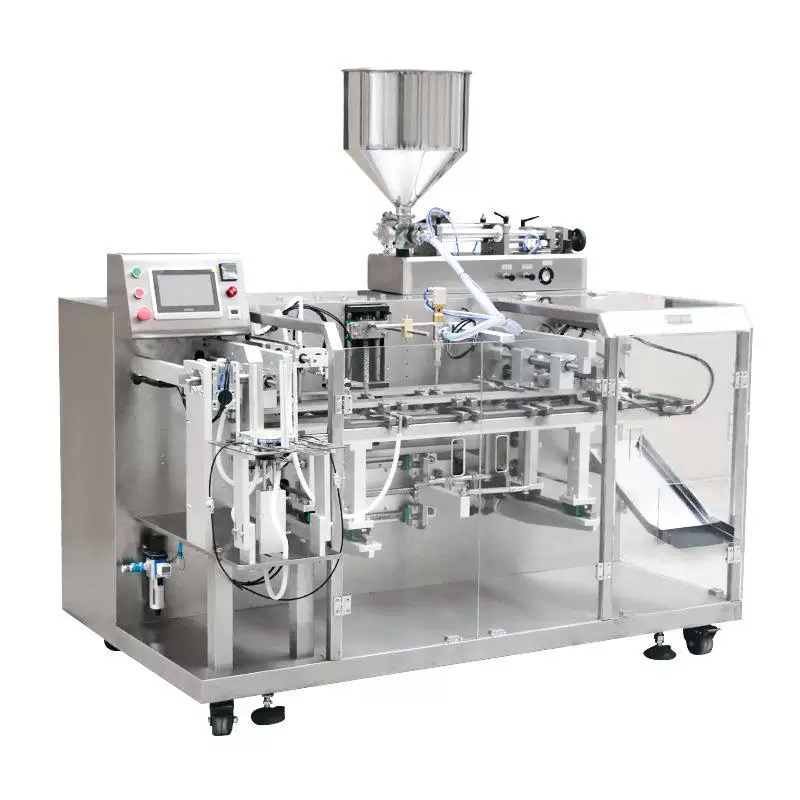
Liquid packaging demands precise fluid dynamics control. You must establish strict specifications for a premade pouch liquid packing machine. Analyze the mechanical advantages of rotary versus inline pouch packing systems. Rotary systems excel in compact footprints and high-speed operations. They move pouches through a circular sequence of stations: loading, opening, filling, and sealing. Inline systems move pouches in a straight line. They offer easier access for maintenance and washdowns.
Pump selection depends entirely on liquid viscosity. Match your fluid characteristics to the correct pumping technology:
Piston Pumps: Ideal for high-viscosity products like peanut butter or heavy sauces.
Lobe Pumps: Best for shear-sensitive liquids containing particulates, such as fruit preserves.
Peristaltic Pumps: Used for sterile liquids where the fluid cannot touch pump mechanics.
Magnetic Flow Meters: Perfect for highly conductive, thin liquids like juices and broths.
Temperature control directly impacts liquid viscosity. Assess the need for heated hoppers above the filling station. Jacketed piping maintains consistent liquid temperatures during production. Consistent temperatures ensure uniform flow rates. Uniform flow rates guarantee accurate fill weights. Cold liquids flow slower and may cause dosing inconsistencies.
Managing splashing and seal integrity prevents catastrophic spoilage. Identify the correct anti-drip nozzle technologies. Bottom-up filling methods lower the nozzle into the pouch before dispensing. The nozzle rises as the liquid fills the pouch. This prevents splashing onto the seal area. Contaminated seals lead to leaks and bacterial growth.
Assess ultrasonic sealing technology for wet environments. Ultrasonic waves vibrate the film molecules to create heat internally. This method easily cuts through liquid contamination to ensure hermetic closures. Traditional heat sealing relies on external conduction and struggles with wet surfaces. If a drop of liquid lands on the seal zone, traditional heat jaws will boil the liquid, creating a pinhole leak in the final package.
A successful facility relies on seamless upstream and downstream integration. Map the integration of material feeding systems. Powders require vacuum conveyors or enclosed bucket elevators. Liquids require sanitary piping and agitated holding tanks. Specify downstream requirements to create a fully connected workflow.
Inline date and batch coding machines ensure traceability. Labeling machines apply branding and nutritional data. Automated cartoning and palletizers prepare the products for shipping. Downstream inspection equipment is mandatory for quality control:
Checkweighers: Reject under-filled or over-filled packages to maintain legal compliance.
Metal Detectors: Identify ferrous, non-ferrous, and stainless steel contaminants.
X-Ray Inspection: Detect glass, bone, high-density plastics, and missing components inside sealed opaque bags.
Facility layout dictates operational efficiency and safety. Determine the required floor space for the entire line. Ensure adequate clearance for maintenance access. Operators need safe walkways around moving machinery. Material staging areas require dedicated square footage. Environmental separation is mandatory for mixed-product facilities.
Environmental Parameter | Dry Powder Zone | Wet Liquid Zone |
|---|---|---|
Ventilation | High-capacity dust extraction, low humidity control. | Standard ventilation, moisture-resistant fixtures. |
Flooring Requirements | Perfectly level, anti-static coating, dry sweep design. | Sloped toward sanitary drains, anti-slip coating. |
Cleaning Protocol | Strict dry-cleaning, vacuuming, tool-less teardown. | High-pressure washdown, chemical foaming. |
Vibration Control | Mandatory for accurate high-speed dosing scales. | Required for checkweigher stability. |
Ensure perfectly level flooring across the entire facility. High-speed dosing scales require absolute stability. Downstream checkweighers lose accuracy on uneven surfaces. Implement vibration isolation zones around sensitive weighing equipment. Heavy forklift traffic can disrupt scale calibration if floors lack proper isolation.
Regulatory compliance drives equipment design in the food industry. Evaluate machine construction against strict hygienic design standards. Look for compliance with FDA, EHEDG, or 3-A sanitary standards. Machine construction materials matter immensely. 316L stainless steel offers superior corrosion resistance compared to standard 304 stainless steel. Use 316L for all liquid contact parts and washdown zones.
Eliminate harborage points across the entire machine. Crevices, exposed threads, and flat surfaces collect bacteria. Tubular frames and sloped surfaces ensure water drains completely.
Sanitation protocols differ drastically between wet and dry lines. Assess the automated cleaning protocols for liquid lines. Clean-in-Place capabilities are mandatory for liquid packaging. Automated systems circulate water, detergents, and sanitizers through the internal piping. Sterilize-in-Place systems use high-pressure steam for complete sterilization. These automated protocols prevent microbial growth. They also prevent cross-contamination between different flavor profiles.
Powder lines require entirely different sanitation approaches. Review dry-cleaning protocols for all powder equipment. Introducing water into a dry powder zone creates massive bacterial risks. Moisture causes residual powder to form hard, concrete-like deposits. Demand tool-less teardown features for powder machines. Operators must easily remove augers, funnels, and hoppers. Parts are taken to a dedicated washroom, cleaned, dried completely, and reinstalled. Never use high-pressure water near dry dosing equipment.
Deploying new packaging technology introduces distinct operational risks. Identifying these risks early prevents catastrophic production failures. Inconsistent seal quality stands as the highest risk factor. Weak seals lead to product spoilage, leaks, and expensive public recalls. Mitigate this risk by implementing automated seal inspection systems. Thermal imaging cameras scan every pouch exiting the machine. They detect microscopic temperature variations indicating a compromised seal. Reject mechanisms automatically remove defective pouches from the line.
Integration bottlenecks frequently derail new facility launches. Connecting machines from different manufacturers causes communication failures. Conveyors may run at conflicting speeds. Data reporting becomes fragmented. Mitigate this by utilizing a single system integrator. Alternatively, require all equipment to use standardized PLC communication protocols. PackML provides a common language for packaging machines. Standardized communication ensures seamless handoffs between the filler, checkweigher, and cartoner.
Product degradation during the filling process reduces final quality. Powders can break apart. Liquids can aerate and foam. Mitigate powder degradation by minimizing drop heights. Use staging gates inside the filling tube to slow the product descent. Mitigate liquid aeration by using bottom-up filling nozzles. Control the pump speed to match the fluid's specific shear sensitivity.
Document a comprehensive User Requirement Specification detailing all material characteristics, throughput targets, and facility constraints.
Request physical material testing using your actual powder and liquid products on the manufacturer's test equipment.
Schedule a rigorous Factory Acceptance Test to verify machine performance, seal integrity, and changeover speeds before shipping.
Establish strict zoning protocols in your facility to physically separate dry powder handling from wet washdown areas.
A: Footprint varies based on automation levels. A basic semi-automated line requires roughly 200 to 400 square feet. Fully integrated systems with upstream feeding, automated filling, checkweighing, and robotic palletizing can exceed 1,500 square feet. Always factor in additional clearance for operator safety and maintenance access.
A: Dust prevention requires enclosed dosing chambers and active vacuum extraction. The machine pulls airborne particles away from the sealing jaws during the fill cycle. Additionally, anti-static bars neutralize static electricity, preventing powder from clinging to the inner film surfaces before the jaws close.
A: Yes, but it requires interchangeable pumping systems. Thin liquids like juice require flow meters or gravity fillers. Thick pastes like peanut butter require robust piston pumps. Modular machines allow operators to swap these dosing heads during format changeovers to handle diverse viscosities.
A: A Vertical Form Fill Seal machine creates its own bags from a continuous roll of flat film, filling and sealing them simultaneously. A premade pouch machine picks up pre-formed, individual pouches from a magazine, opens them, fills the product, and seals the top.
A: Clean-in-Place requires a four-step automated process: a pre-rinse to remove loose debris, a caustic chemical wash to break down fats and proteins, a fresh water rinse, and a final sanitizing flush. The system must maintain specific flow velocities and temperatures to guarantee sanitation.
A: Modern servo-driven machines feature tool-less changeovers that take between 15 and 30 minutes. This involves swapping forming tubes, adjusting guide rails, and selecting a new recipe on the HMI. Older mechanical systems requiring manual wrench adjustments can take several hours to reconfigure.


