
Views: 0 Author: Site Editor Publish Time: 2026-07-27 Origin: Site


Choosing between a flow wrapping machine vs pouch packing machine is a common decision for food, daily chemical, hardware, pharmaceutical, and consumer product manufacturers. Both machines are used for flexible packaging, both can improve packing speed, and both can reduce manual labor. However, they are designed for different products, package styles, automation goals, and market positioning.
A flow wrapping machine is usually used for regular-shaped solid products. It forms a pillow pack from roll film, wraps the product horizontally, seals the film, and cuts each finished pack. This is why a flow wrapping machine is also often called a pillow packing machine or horizontal packing machine. It is widely used for bakery products, biscuits, candy bars, soap, masks, hardware parts, medical supplies, and other products that can be fed in a stable horizontal direction.
A pouch packing machine is different. It is designed to fill and seal products into pouches. Depending on the machine type, it may use premade pouches or form pouches from roll film. It is commonly used for powders, liquids, granules, pastes, sauces, snacks, pet food, coffee, detergent, and meal ingredients. Compared with flow wrapping, pouch packing is more closely related to filling accuracy, product behavior, pouch opening, sealing cleanliness, and package presentation.
At Onfocuspack, we provide packaging machinery for different product forms and packaging needs, including horizontal packing machines, premade pouch packing machines, sachet packing machines, multi-lane packing machines, and large bag vertical packing machines. This product structure allows buyers to compare flow wrap, pouch, sachet, and vertical bagging solutions based on real product requirements instead of choosing only by machine name.
A flow wrapping machine is best for solid products that can be wrapped in pillow packs, while a pouch packing machine is best for products that need to be filled into pouches, especially powders, liquids, granules, sauces, pastes, and premium retail packs.
Comparison Item | Flow Wrapping Machine | Pouch Packing Machine |
|---|---|---|
Main packaging method | Wraps product with roll film | Fills product into premade or formed pouches |
Common package style | Pillow pack | Stand-up pouch, flat pouch, zipper pouch, spout pouch, sachet |
Typical machine direction | Horizontal | Horizontal, rotary, vertical, or multi-lane |
Best for | Regular solid products | Powder, liquid, granule, paste, sauce, snacks |
Product feeding | Product is placed on infeed conveyor | Product is dosed by filler, pump, weigher, or auger |
Packaging material | Roll film | Premade pouch or roll film |
Typical speed | High for regular items | Depends on product, pouch type, and filling system |
Branding effect | Functional and efficient | Stronger for retail presentation |
Filling accuracy | Usually not the main focus | Very important |
Main selection factor | Product shape and feeding stability | Product behavior, filling volume, and pouch format |
In simple terms, choose a flow wrapping machine when you need to wrap individual solid items. Choose a pouch packing machine when you need to fill a measured amount of product into a pouch.
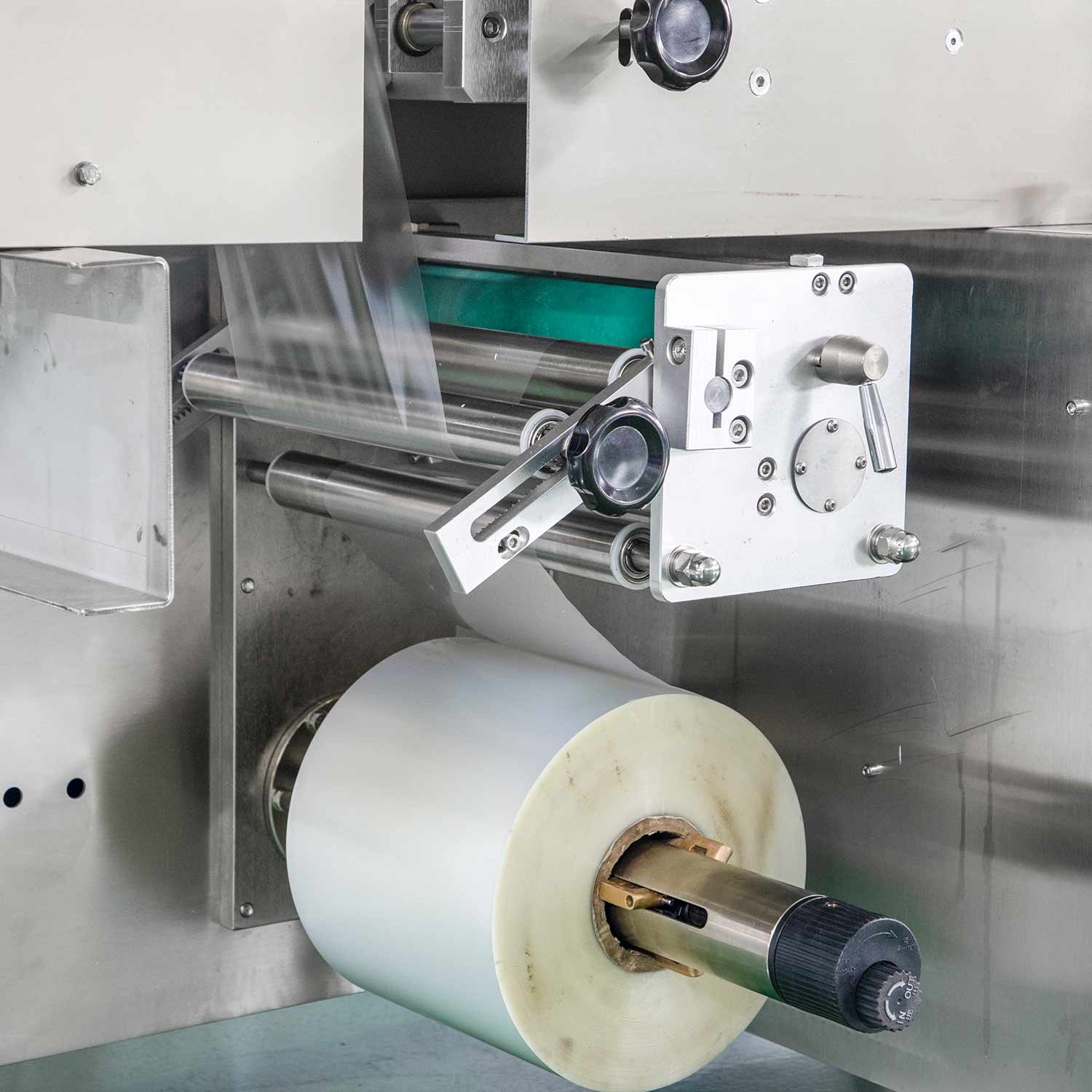
A flow wrapping machine is a horizontal packaging machine that wraps products in a continuous roll of film. The product is placed on an infeed conveyor, the film forms around the product, the longitudinal seal is made, and the end seals are created before cutting each pack. The final package is usually a pillow pack.
A flow wrapping machine is often used for products with a stable shape, size, and feeding direction. It is especially suitable when products can be placed one by one on a conveyor or automatically fed from an upstream production process.
Common products for a flow wrapping machine include:
Biscuits and cookies
Chocolate bars and candy
Bread and bakery products
Instant noodles blocks
Soap bars
Wet wipes
Medical masks
Syringes or medical items
Hardware parts
Stationery products
Small household items
Frozen food portions with stable shape
A flow wrapping machine is also called a pillow packing machine because it usually produces a pillow-shaped pack. The package is simple, efficient, and suitable for high-speed production. For many factories, the biggest advantage is continuous packaging speed and low material cost when the product shape is consistent.
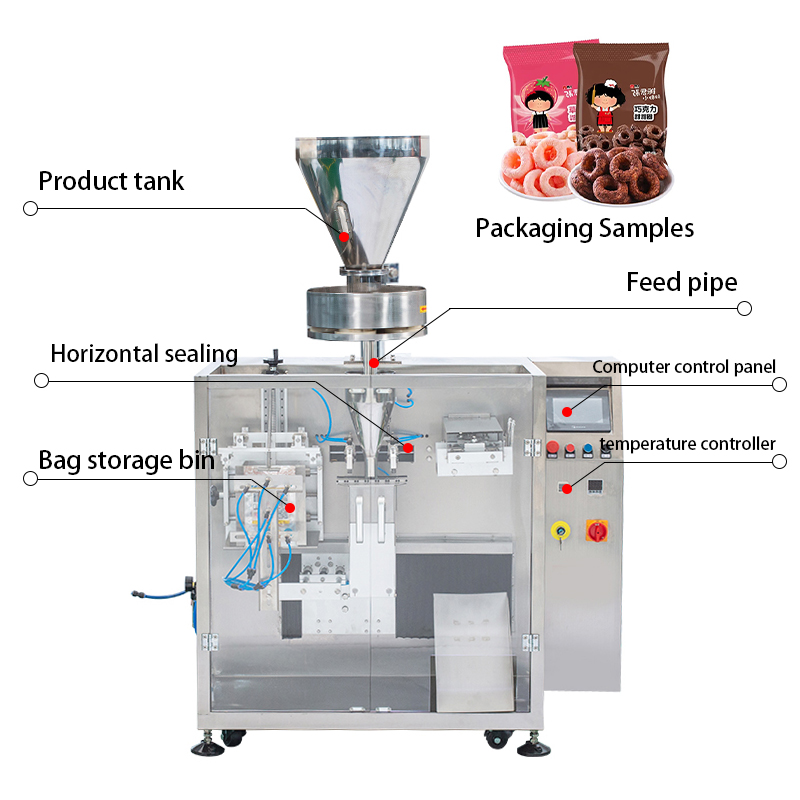
A pouch packing machine fills and seals products into flexible pouches. The pouch may be a ready-made premade pouch or a pouch formed from roll film. Unlike a flow wrapping machine, which wraps around a solid item, a pouch packing machine usually focuses on dosing and filling a product into a bag.
A pouch packing machine can be configured with different filling systems, such as:
Auger filler for powders
Pump filler for liquids
Piston filler for sauces and pastes
Cup filler for small granules
Linear scale for granules
Multihead weigher for snacks or irregular pieces
Counting system for small parts
A pouch packing machine is commonly used for:
Coffee powder
Spice powder
Milk powder
Sauce and paste
Shampoo and detergent
Rice, sugar, salt, and seeds
Pet food
Snacks and nuts
Ready meal ingredients
Pharmaceutical granules
Agricultural products
For retail packaging, a pouch packing machine can support more package styles than a flow wrapping machine. Premade pouch systems can handle stand-up pouches, zipper pouches, flat pouches, spout pouches, and shaped pouches. This makes pouch packing suitable for brands that care about shelf display, consumer convenience, and packaging differentiation.
The most important difference in flow wrapping machine vs pouch packing machine is the packaging logic.
A flow wrapping machine wraps around a product. The product already has a fixed shape before entering the machine. The machine’s job is to cover it with film, seal it, and cut the finished pack.
A pouch packing machine fills a product into a pouch. The product may be powder, liquid, paste, granule, or irregular pieces. The machine must dose the product accurately, fill it cleanly, seal the pouch, and prevent leakage or contamination.
Process Step | Flow Wrapping Machine | Pouch Packing Machine |
Product condition before packing | Usually solid and shaped | May be powder, liquid, granule, paste, or solid |
Package creation | Film wraps around the product | Pouch is opened or formed, then filled |
Main challenge | Product feeding and film wrapping | Filling accuracy and sealing quality |
Package output | Pillow pack | Pouch, sachet, stand-up pouch, zipper pouch, spout pouch |
Best production style | Continuous wrapping | Dosing, filling, and sealing |
Typical machine name | Flow wrapping machine, pillow packing machine, horizontal packing machine | Pouch packing machine, premade pouch machine, sachet machine |
This is why the decision should start with the product. If the product can be pushed or placed into a film tunnel, flow wrapping may work. If the product must be measured and filled into a bag, pouch packing is usually more suitable.
The comparison of pillow pack vs pouch is often the easiest way to understand the machine difference.
A pillow pack is usually made from roll film on a flow wrapping machine or vertical form fill seal machine. It has a simple pillow-like shape, with seals along the back and ends. It is efficient, lightweight, and cost-effective.
A pouch can refer to many flexible package formats, including flat pouches, stand-up pouches, zipper pouches, spout pouches, gusseted pouches, shaped pouches, and sachets. Pouches are often used when the product needs better display, resealability, controlled filling, or a more premium retail appearance.
Package Type | Typical Machine | Best For | Main Advantage |
Pillow pack | Flow wrapping machine or pillow packing machine | Solid products, bakery, candy, hardware | Fast, economical, efficient |
Flat pouch | Pouch packing machine | Powder, granule, liquid, sample packs | Simple and versatile |
Stand-up pouch | Premade pouch packing machine | Coffee, snacks, pet food, sauce | Strong shelf display |
Zipper pouch | Premade pouch packing machine | Reusable food or powder packs | Consumer convenience |
Spout pouch | Pouch packing machine | Liquid, sauce, puree, detergent | Easy pouring |
Sachet | Sachet packing machine | Small-dose powder, liquid, granule | Low cost and high speed |
If the buyer’s main concern is cost and speed for individual solid items, pillow packs are often enough. If the buyer’s main concern is branding, resealing, shelf impact, or multi-product filling, pouches are usually stronger.
A flow wrapping machine is usually the better choice when the product is solid, regularly shaped, and suitable for continuous horizontal feeding.
Choose a flow wrapping machine when:
The product is a single solid item.
The product shape is relatively stable.
The package can be a pillow pack.
High-speed wrapping is important.
The product can be placed on an infeed conveyor.
The factory wants lower packaging material cost.
The package does not require zipper, spout, or stand-up structure.
The product is sold as individual pieces or grouped items.
The upstream production process can feed items continuously.
A pillow packing machine is especially useful for factories packing large volumes of simple, regular products. For example, a bakery factory may use a flow wrapping machine to pack bread or cookies. A hardware factory may use a horizontal packing machine to wrap small parts or kits. A daily chemical factory may use it to pack soap bars or wipes.
However, flow wrapping is not suitable for every product. Loose powder, liquid, sticky paste, and free-flowing granules usually cannot be handled directly by a standard flow wrapper unless they are already contained in another primary package.
A pouch packing machine is usually the better choice when the product needs dosing, filling, and pouch sealing.
Choose a pouch packing machine when:
The product is powder, liquid, paste, granule, or small pieces.
Filling accuracy matters.
The product needs a stand-up pouch, zipper pouch, or spout pouch.
The package must support better shelf presentation.
The product requires controlled dosing by weight or volume.
The seal area must be protected from dust or liquid residue.
The factory packs multiple filling volumes or SKUs.
The product needs a premium retail pouch.
The packaging project may require inspection, coding, or downstream automation.
A pouch packing machine is especially suitable for food, chemical, agricultural, and pharmaceutical products. For example, coffee powder may require an auger filler and zipper pouch. Sauce may require a piston pump and anti-drip nozzle. Rice or pet food may require a weighing system and stand-up pouch. Each product needs a different filling system.
Product type is the most important factor in flow wrapping machine vs pouch packing machine selection.
Product Type | Better Machine Choice | Reason |
Biscuit or cookie | Flow wrapping machine | Regular solid shape and high-speed wrapping |
Chocolate bar | Flow wrapping machine | Easy horizontal feeding |
Bread or bakery item | Flow wrapping machine | Pillow pack is common and efficient |
Soap bar | Flow wrapping machine | Stable shape and simple film wrap |
Medical mask | Flow wrapping machine | Flat product and clean individual pack |
Coffee powder | Pouch packing machine | Requires dosing and pouch filling |
Chili sauce | Pouch packing machine | Requires pump or piston filling |
Rice or seeds | Pouch packing machine | Requires weighing or volumetric filling |
Pet food | Pouch packing machine | Needs weighing and strong pouch format |
Snack mix | Pouch packing machine | Needs multihead weighing |
Hardware kit | Depends | Flow wrap for flat kits, pouch packing for counted parts |
Meal ingredients | Pouch packing machine | May require multiple dosing systems |
Some products may use both machines in different packaging stages. For example, a sauce sachet may first be packed by a pouch or sachet machine, then grouped and wrapped by a flow wrapping machine for multipack sales. This is why factories should evaluate the complete packaging process, not only the first machine.
Cost is another important part of the flow wrapping machine vs pouch packing machine decision.
A flow wrapping machine usually has lower packaging material cost because it uses roll film and creates a simple pillow pack. It can also reach high speeds for regular products, which may reduce cost per finished pack.
A pouch packing machine may require a higher investment, especially if it uses premade pouches, advanced filling systems, zipper pouch handling, inspection systems, or customized automation. However, it can create higher-value packages and support more product types.
Cost Factor | Flow Wrapping Machine | Pouch Packing Machine |
Packaging material cost | Usually lower | Usually higher for premade pouches |
Machine investment | Varies by speed and automation | Varies by filler, pouch type, and customization |
Labor saving | Strong for solid item wrapping | Strong for filling and sealing automation |
Product waste control | Depends on feeding stability | Depends on dosing accuracy and sealing |
Branding value | Moderate | Higher for retail pouches |
Changeover cost | Depends on film and product size | Depends on pouch size, filler, and machine setup |
Best ROI case | High-volume regular solid products | Product lines needing accurate filling and better packaging value |
The lowest machine price is not always the best choice. A factory should compare cost per finished pack, labor requirement, product waste, downtime, changeover time, and sales value of the final package.
A flow wrapping machine can often run very fast when the product is regular and feeding is stable. Since the machine continuously pulls film and wraps items, it is well suited for high-speed production lines.
A pouch packing machine speed depends more on filling and pouch handling. Powder filling may need controlled dosing to reduce dust. Liquid filling may need time to avoid dripping. Granule filling may depend on weighing speed. Premade pouch packing also requires pouch picking, opening, filling, sealing, and output.
Production Need | Recommended Direction |
High-speed wrapping of regular solid items | Flow wrapping machine |
Individual pillow packs for bakery or candy | Pillow packing machine |
Powder filling into pouches | Pouch packing machine |
Sauce or paste pouches | Pouch packing machine |
Stand-up pouch with zipper | Pouch packing machine |
Simple solid products in pillow packs | Horizontal packing machine |
Multi-SKU retail pouch packaging | Pouch packing machine |
Secondary wrapping for grouped items | Flow wrapping machine |
PMMI notes that flexible packaging formats such as pouches, flow wraps, and stick packs continue to gain market share because of efficiency, convenience, and reduced material usage. PMMI also highlights modular and quick-change packaging equipment as manufacturers deal with shorter production runs and greater SKU variability. These trends show why both flow wrapping and pouch packing remain important, but the best choice depends on the factory’s product mix and changeover needs.
A flow wrapping machine creates clean, functional packaging, but the package format is usually limited to pillow packs. This can be perfect for products where the package is mainly used for protection, hygiene, portion control, or transport.
A pouch packing machine offers stronger branding potential when it supports premade pouches, stand-up pouches, zipper pouches, or spout pouches. These packages can provide more front-facing display area, better shelf stability, and more consumer convenience.
Choose flow wrapping when:
The product sells mainly by unit count.
The package only needs basic protection.
High speed and low cost matter most.
Pillow pack appearance is acceptable.
The product is already visually recognizable.
Choose pouch packing when:
Shelf presentation is important.
The product needs a premium look.
The pouch needs a zipper or spout.
More printing area is needed.
The package must stand upright.
The product is sold through retail or e-commerce channels.
For example, a biscuit may not need a stand-up pouch if a pillow pack is enough. But coffee powder, pet food, nuts, sauce, or meal ingredients may benefit from a pouch because the package itself helps communicate product value.
The mechanical structure of a flow wrapping machine is different from a pouch packing machine.
A flow wrapping machine usually includes an infeed conveyor, film roll holder, film forming box, longitudinal sealing unit, end sealing jaws, cutting system, and discharge conveyor. Maintenance focuses on film tension, sealing temperature, cutter condition, product feeding timing, and conveyor synchronization.
A pouch packing machine may include pouch loading, pouch picking, pouch opening, product dosing, filling, vibration or settling, sealing, cooling, coding, inspection, and discharge. Maintenance focuses on grippers, suction cups, sealing bars, filling nozzles, dosing systems, sensors, and pouch feeding accuracy.
Maintenance Area | Flow Wrapping Machine | Pouch Packing Machine |
Film control | Very important | Important for roll-film pouch systems |
Product feeding | Very important | Product dosing is more important |
Sealing jaws | Very important | Very important |
Cutting system | Very important | Depends on machine type |
Pouch opening | Not needed | Very important |
Filling system | Usually not central | Core system |
Cleaning | Product contact may be limited | Important for food, liquid, powder, and paste |
Changeover | Product size and film adjustment | Pouch size, filling system, and sealing adjustment |
Both machine types require preventive maintenance, but the maintenance focus is different. A buyer should consider operator skill level, cleaning frequency, spare parts, and after-sales support before purchasing.
Sustainability is now part of packaging machinery selection. Buyers are paying attention to material reduction, recyclable films, mono-material structures, package size optimization, energy use, and waste reduction.
A flow wrapping machine may help reduce packaging material for simple products because pillow packs can be lightweight and efficient. A pouch packing machine may support consumer convenience, resealability, and better product protection, which can reduce product waste after opening.
Recent industry coverage also shows growing pressure on flexible plastic packaging, including bags, wraps, and pouches, because these formats are widely used but difficult to recycle in many markets. Some regions are introducing stronger rules on recycled content, collection, and recyclability. This makes machine compatibility with new materials more important for both flow wrapping and pouch packing projects.
Before choosing a machine, buyers should ask:
Can the machine run recyclable film?
Can it seal thinner films reliably?
Can it handle mono-material packaging?
Does it reduce defective packs?
Does it support accurate filling to reduce giveaway?
Can sealing temperature and pressure be adjusted for new materials?
Can the machine be upgraded when packaging materials change?
The future is not only about faster machines. It is also about flexible equipment that can handle changing films, packaging formats, and sustainability requirements.
Use this checklist when comparing flow wrapping machine vs pouch packing machine:
Question | If Yes, Consider |
Is the product a regular solid item? | Flow wrapping machine |
Do you need pillow packs? | Pillow packing machine |
Does the product need horizontal continuous wrapping? | Horizontal packing machine |
Is the product powder, liquid, paste, or granule? | Pouch packing machine |
Do you need accurate dosing? | Pouch packing machine |
Do you need stand-up pouches or zipper pouches? | Pouch packing machine |
Is low material cost the main goal? | Flow wrapping machine or roll-film solution |
Is retail shelf display important? | Pouch packing machine |
Do you need very high-speed single-item packs? | Flow wrapping machine |
Do you pack several product types? | Customized pouch packing line or mixed solution |
Do you need secondary wrapping after pouch packing? | Flow wrapping machine may be added downstream |
The best solution may not be one machine only. Some factories use a pouch packing machine for primary packaging and a flow wrapping machine for secondary wrapping. Others use flow wrapping for solid products and pouch packing for powders or liquids in the same facility.
We help buyers evaluate the full packaging process before recommending a machine model. Instead of choosing equipment only by product name, we review product characteristics, package format, filling volume, target speed, packaging material, factory layout, and future production plans.
For flow wrapping projects, the key questions include product size, shape, feeding method, film type, target speed, sealing requirement, and whether the final package should be a pillow pack.
For pouch packing projects, the key questions include product flow behavior, filling method, pouch type, pouch size, dosing accuracy, sealing quality, cleaning needs, inspection requirements, and whether the buyer needs a single machine or a complete packaging line.
We provide horizontal packing machines for products suitable for flow wrap or pillow packaging, and we also provide pouch packing machine solutions for powders, liquids, granules, sauces, and other materials. This allows buyers to compare different packaging directions based on production reality instead of forcing one machine type to fit every product.
A flow wrapping machine is not designed to fill loose powder or liquid directly into a pouch. If the product needs dosing, weighing, or pumping, a pouch packing machine is usually more suitable.
If the product is a regular solid item and only needs a basic pillow pack, a pouch packing machine may be more complex than necessary. A pillow packing machine may provide faster and more economical production.
Flow wrapping performance depends heavily on stable feeding. If products are irregular, sticky, fragile, or difficult to align, the feeding system must be reviewed carefully.
For pouch packing, powders can create dust and sauces can contaminate the sealing area. The filling system, nozzle design, and pouch holding structure must be selected carefully.
Catalog speed does not always equal real production speed. Product behavior, film material, pouch type, filling volume, operator skill, and downstream packing can all reduce actual output.
A factory may start with pillow packs but later need stand-up pouches, zipper bags, or multipacks. Future SKUs and packaging formats should be discussed before buying equipment.
A bakery factory packing bread slices or cookies may choose a flow wrapping machine because the product is solid, repeatable, and suitable for pillow packs. The main concerns are feeding stability, film sealing, product freshness, and output speed.
A coffee brand packing instant coffee sticks may need a roll-film sachet or stick pack system. A premium roasted coffee brand packing 250 g zipper pouches may need a pouch packing machine. The correct choice depends on package format and market positioning.
A sauce manufacturer usually needs a pouch packing machine because the product must be metered and filled. A piston pump, anti-drip nozzle, and clean sealing design are more important than flow wrapping speed.
A hardware supplier packing flat accessory kits may use a flow wrapping machine. If the supplier needs to count screws into small pouches, a pouch packing machine with a counting system may be more suitable.
A meal kit factory may use several machines. Dried noodles or solid components may be flow wrapped, while seasoning powder and sauce may be packed by pouch or sachet machines. The final products may then be grouped into a larger secondary package.
The choice between flow wrapping machine vs pouch packing machine depends on product form, package style, speed target, cost, branding, filling requirements, and future production plans. A flow wrapping machine is usually the best choice for regular solid products that need fast and economical pillow pack packaging. It is also commonly called a pillow packing machine or horizontal packing machine because it wraps products horizontally in roll film.
A pouch packing machine is the better choice when the product needs dosing, filling, and sealing into pouches. It is suitable for powders, liquids, granules, sauces, pastes, snacks, pet food, coffee, detergent, agricultural products, and meal ingredients. It also provides stronger flexibility for stand-up pouches, zipper pouches, spout pouches, and premium retail packaging.
The comparison of pillow pack vs pouch should not be based only on appearance. It should include product behavior, filling accuracy, packaging material, machine speed, labor cost, sealing quality, shelf presentation, and long-term growth. For some factories, a flow wrapping machine is the most efficient solution. For others, a pouch packing machine provides better product fit and brand value. For complex projects, both machines may be used together in one packaging process.
Before making a final decision, prepare product samples, package drawings, film or pouch specifications, target speed, factory layout, and future SKU plans. A professional packing machine manufacturer can then help you select a practical solution that supports stable production today and leaves room for tomorrow’s packaging needs.
A flow wrapping machine can pack some irregular solid products, but feeding stability becomes more difficult. If the product cannot be aligned or transferred smoothly on the infeed conveyor, a customized feeding system or another packaging method may be needed.
Some roll-film pouch or vertical packing systems can produce pillow-style bags, but a standard premade pouch packing machine does not usually make pillow packs. If the main package is a pillow pack for solid items, a pillow packing machine or flow wrapping machine is usually more suitable.
It depends on the multipack structure. If several wrapped items need to be grouped into one outer film pack, a flow wrapping machine may be suitable. If several ingredients need to be dosed into one pouch, a pouch packing machine or customized packing line may be better.
A horizontal packing machine can work with many heat-sealable roll films, but the exact material depends on product protection needs, sealing temperature, barrier performance, and machine compatibility. Film testing is recommended before final machine confirmation.
Start with the product form. If it is a regular solid item and only needs film wrapping, pillow packing is usually suitable. If it needs measured filling, better retail presentation, resealing, or liquid/powder/granule handling, pouch packing is usually the better direction.


