
Views: 0 Author: Site Editor Publish Time: 2026-06-25 Origin: Site


You want to pick the best packing machines for your business. If your production line makes a lot of products, automatic packing is the best choice. If you make small batches or change packaging types often, semi-automatic machines are more flexible. Choosing machines that fit your needs, budget, and goals gives you the most value.
Automatic packing machines help high-volume production lines.
Semi-automatic machines are good for flexible lines or small budgets.
If you do not have many workers, automation is a good idea.
Think about your own production setup as you read.
Pick automatic packing machines if you make a lot of products. They work quickly and need less help from people.
Choose semi-automatic machines if you want more choices. They work well for small groups of items and when you change products often.
Think about how much money you can spend. Automatic machines cost more at first but save money on workers later.
Look at what your production needs are. Automatic machines are good for the same products, but semi-automatic machines can handle different things.
Make sure you have enough room. Automatic machines take up more space and need more setup. Semi-automatic machines can fit in smaller places.
Automatic filling machines are used in many businesses. These machines fill, seal, and label products with little worker help. You can find them in food, medicine, cosmetics, chemicals, and pet food. They do jobs like bottling drinks, sealing jars, and putting labels on packages. You set up the machine, and it runs by itself most of the time. Automatic systems work quickly and keep things moving. They help you make more products and have fewer mistakes.
Tip: Automatic packing machines work best for big production lines that need to be fast and correct.
Automatic packing machines are good for food, drinks, medicine, and cosmetics. They can pack both flexible and hard packages. Fully-automatic machines are great for making lots of products and growing your business.
Semi-automatic filling machines need more worker help. You put the products or containers in by hand, and the machine fills or seals them. These machines are good for new businesses, small batches, or when you change products a lot. You can use them for food, cosmetics, and chemicals. Semi-automatic machines give you more control and let you change things easily. You can switch between products fast and change settings without trouble.
Note: Semi-automatic machines are best for small production lines or when you need to change packaging often.
Semi-automatic packing machines work well with light materials and strong containers. They are used in packaging lines for food, medicine, and cosmetics.
Factor | Semi-Auto | Full Auto |
|---|---|---|
Operator involvement | High | Low |
Speed | 5–20 units/min | 20–120 units/min |
Initial investment | $15,000–$60,000 | $60,000–$300,000+ |
Changeover time | 10–30 min | 30–90 min |
Best for | Startups, small batches | Scale-up, high volume |
Automatic machines give you more speed and automation. Semi-automatic machines cost less and let you be flexible. Packing machines help you reach your business goals and fit your needs.
Packing machines are important in packaging lines for food, medicine, cosmetics, chemicals, and pet food.
There are big differences in how these machines work. Automatic machines do most jobs by themselves. You just set up the machine and watch it. Semi-automatic machines need you to load items and start them. Automatic packing gives fast speed and steady work. Semi-automatic machines need your skill and focus. If you want less work for people, pick automatic machines.
Automatic machines pack faster than semi-automatic ones.
Semi-automatic machines need more help from people, which can slow things down.
Automatic machines make work easier for workers and help things run better.
Automatic machines give the same results every time.
How many workers you need is very different. Automatic machines need little help from people. You mostly watch and fix problems if they happen. Semi-automatic machines need you to put in bags, load items, and start sealing. So, you need more workers for semi-automatic machines.
Machine Type | Labor Requirement |
|---|---|
Semi-Automatic | Needs 1-2 operators per machine |
Automatic | Minimal labor, mostly monitoring |
Automatic machines can save you 50-70% on worker costs compared to semi-automatic ones.
Speed is a big reason to pick automatic machines. Automatic machines run fast and keep the same speed all day. Semi-automatic machines are slower because people control them. Workers can get tired and slow down.
Machine Type | Daily Output (Units) | Key Features |
|---|---|---|
Automatic Machines | 10,000 - 25,000 | Runs all day, needs little help, keeps steady speed |
Semi-Automatic Machines | 1,000 - 5,000 | Needs people to load, speed changes with workers |
If you want to pack things quickly, automatic machines are best.
Sometimes you need to change what you pack. Semi-automatic machines let you switch products easily. You can change settings fast and do small or special orders. Automatic machines are better for packing the same thing for a long time. Changing products on automatic machines takes longer and is harder.
Machine Type | Flexibility and Adaptability |
|---|---|
Semi-Automatic | Can pack many things and change settings easily |
Automatic | Best for lots of one product; slower to change |
How you set up the machines matters too. Semi-automatic machines are easy to install and cost less. You can add them to your line one at a time. Automatic machines need more wires and cost more at first. They work best in big spaces with lots of work.
Semi-automatic machines are easy to set up and good for new businesses.
Automatic machines need special wires and cost more to install.
Fully-automatic machines are fastest and most accurate but need more planning.
Pick the machine that fits your work, money, and goals.
Automatic packing machines have many good points. They help your production line go fast. You can keep packing all day without stopping. This helps you finish big orders on time. You do not need a lot of workers. The machines do most jobs by themselves. This saves money because you pay fewer workers. Automatic filling machine models keep your packing speed steady.
If your business gets bigger, fully-automatic packers can handle more work and stay fast.
Here are the main pros of automatic packing:
High speed for big orders
No breaks, so work keeps going
Fewer workers needed, so labor costs are lower
Quality stays steady and mistakes are rare
Works well in big factories with automated packing
But automatic packing machines have some downsides:
They cost a lot to buy and set up
You need more space and special setup
Not easy to change products often
Takes longer to switch between products
Pick fully-automated packing if you want to grow and keep your line fast.
Semi-automatic packers let you control your packing better. You can change products quickly. These machines are good for small batches or when you switch packaging often. Semi-automatic filling machines cost less and are easy to set up. You can use them if your team is small or you do not have much space.
Semi-automated packing lets you change your process for special orders or new products.
Here are the main pros of semi-auto machines:
Lower price and easy setup
Flexible for many products and quick changes
Good for new businesses or small lines
Simple to use and fix
But semi-automatic machines have some downsides:
Slower packing speed than full-automatic machines
Need more workers to run
Hard to keep steady work for big orders
Not great for high-speed production
Pick semi-automatic if you want flexibility and lower costs for your packing line.
When you look at packing machines, price is important. Automatic systems cost more than semi-automatic packers. You pay extra for speed and less work for people. Semi-auto machines cost less at first. This helps if your budget is small or you want to try new products.
Automation Level | Equipment Cost | Best For |
|---|---|---|
Semi-automatic FFS | $15,000-$50,000 | Mid-volume, flexibility needed |
Fully automatic VFFS | $75,000+ | High volume, consistent products |
Tip: If you want to grow your production, buying a fully-automatic filling machine can save money later.
You need to think about more than just the price. Automatic packing systems need fewer workers, so you pay less in wages. They can run longer without stopping. But, you might pay more for fixing and parts. Semi-automatic packers need more people, so labor costs go up. Fixing them is usually easier and cheaper. But, you might lose time if a worker makes a mistake.
Here is a look at three-year costs for American-made and international auto machines:
Cost Category | American-Made | International | Difference |
|---|---|---|---|
Initial Purchase | $250,000 | $180,000 | -$70,000 |
Installation & Setup | $15,000 | $25,000 | +$10,000 |
Training Costs | $8,000 | $12,000 | +$4,000 |
Year 1-3 Maintenance | $25,000 | $35,000 | +$10,000 |
Parts & Repairs (3 yrs) | $18,000 | $45,000 | +$27,000 |
Downtime Costs (3 yrs) | $12,000 | $65,000 | +$53,000 |
Support & Service | $22,000 | $18,000 | -$4,000 |
Shipping & Import | $5,000 | $35,000 | +$30,000 |
TOTAL 3-YEAR TCO | $355,000 | $415,000 | +$60,000 |
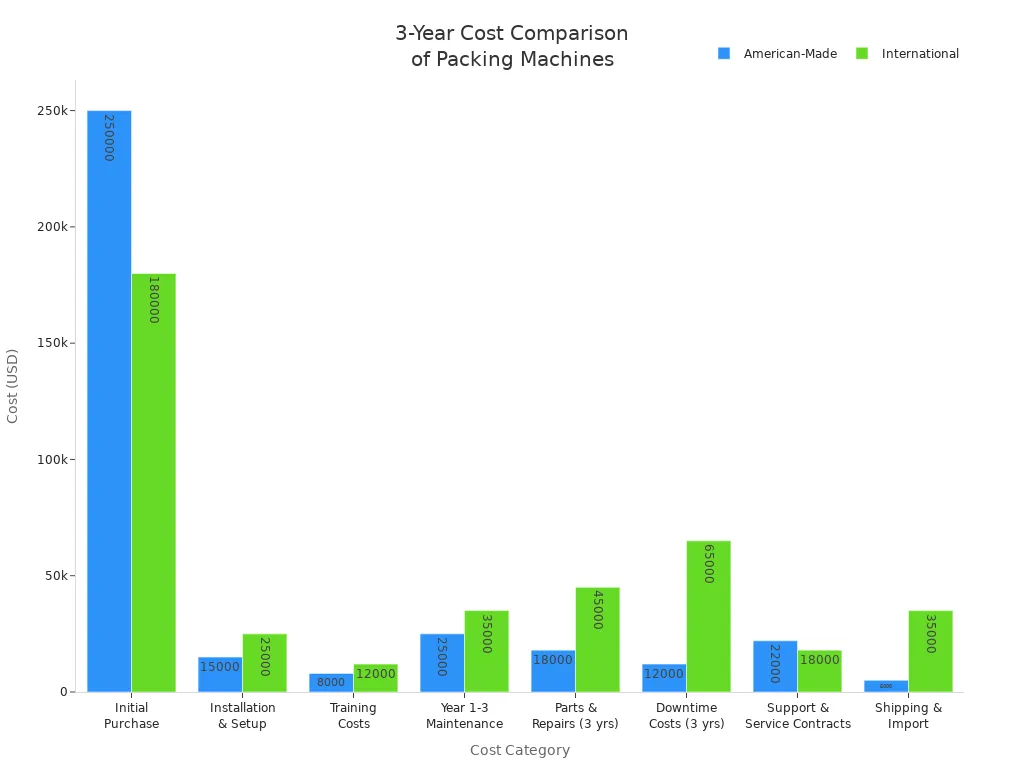
Automatic packing machines are a good value over time. They help you make more products and use fewer workers. These machines do the same jobs again and again. They use materials well and make fewer mistakes. You also get less downtime, especially with remote monitoring. Many companies get their money back fast. For example, a snack food company in the Midwest made 40% more products and had 95% less downtime after getting a fully-automated packing line. The company set up the machines in two weeks. They saved money by using fewer workers and making more products. Semi-automatic machines are best for small jobs and lower budgets. They are good for businesses that want flexibility and do not want to spend a lot at first.
You want your packing line to work well. Automatic machines help you make lots of products. These machines use special steps to fill and pack items. They keep the same speed and quality all day. Workers do not get tired or make mistakes. One person can watch many automatic filling machine lines. This means you need fewer workers to do more jobs.
Automatic machines keep steady speed and quality with sensors.
You see less change in your products, so you follow rules.
You spend less money on workers as your business grows.
Fully-automatic packers are best for big jobs.
Semi-automatic packers let you control and change things easily. You can switch between products quickly. These machines are good for short runs or mixed lines. You need more workers, and output changes if someone gets tired. Semi-auto systems let you check quality closely, but you may see more changes over long shifts.
Downtime and changeover times affect how much you make. Automatic machines take longer to switch products. You may need 30 to 60 minutes to change a fully-automatic line. You must reset sensors and adjust parts. But, you get less downtime during normal work because the system runs by itself.
Semi-automatic packers switch products much faster. You can change products in 5 to 15 minutes. This helps you handle small orders or special requests. You spend less time setting up, but you may stop more for worker breaks or checks.
Machine Type | Changeover Time (minutes) |
|---|---|
Semi-Automatic | 5 to 15 |
Automatic | 30 to 60 |
If you want high productivity and less labor, pick automated packing. If you need flexibility and quick changes, semi-automatic systems are better. Packing machines help you balance speed, quality, and cost in your production line.
Picking the right packing machine can seem hard. You want a machine that fits your needs, money, and goals. This section gives you easy steps to help you choose. You will think about how much you make, your budget, what you pack, and your workers and space.
You need to know how much you want to pack each day. This helps you pick between auto and semi-auto machines. Here are some things to think about:
Automation level: High automation is good for lots of products. Lower automation is better for small jobs.
Production capability: Pick a machine that fits your work. Some machines do big batches, others do small ones.
Production speed: Count how many bags or boxes you need each minute. Make sure your machine can do this.
Labor requirements: Auto machines need fewer workers and work the same way each time. Semi-automatic machines need more people to help.
If you need to pack thousands of things each day, auto machines are best. If you do small jobs or special orders, semi-automatic machines give you more control.
Tip: Write down how much you want to pack each day. Check if each machine can do this.
Your budget is a big part of your choice. You want a machine that fits your money and helps your business grow. Think about the price now and how much you save later.
Even though auto machines cost more at first, they save money over time. Do the math to see if the money you save is worth the price.
Buying the right machine is important. You should look at what you get for the price. Try to save money but still get a good machine.
Auto pouch-packing machines help you pay fewer workers.
Semi-automatic machines are good if you do not have much money.
You can check ROI by looking at worker costs, how much you use, speed, quality, and safety. Auto machines pack faster, so you fill orders quickly. Many companies get their money back in one to three years because they pack more and need fewer workers. Auto machines save money by making fewer mistakes and stopping less.
What you pack can change your choice. If you pack many things or change often, you need a flexible machine. Some machines are better at this than others.
Packing Type | Flexibility and Suitability | Best For |
|---|---|---|
Manual Packing | Very flexible for small jobs, special orders, and different needs. | Small jobs, many products, special orders. |
Automatic Packing | Works best for lots of the same thing, but not as flexible. | Long jobs, same size, not many changes. |
Semi-automatic machines let you switch products fast. You can change settings for new orders. Auto machines are best for packing the same thing for a long time. If you need to pack many types or sizes, semi-auto machines give you more choices.
Note: Think about how often you change what you pack. Pick a machine that fits how you work.
Workers and space matter when you get new machines. You want to use your team and space well.
Auto vertical packing machines are good for making lots of products. They are fast and work well. You need more money and space to set them up. These machines let workers do harder jobs and help your business.
Semi-automatic machines help you work better and pay fewer workers. They do not need much space. You can use them in small places or if you want your team to do many jobs.
Machine Type | Labor Considerations | Space Considerations |
|---|---|---|
Semi-Automatic | Makes work faster, saves money, lets workers do other jobs | Needs less space to set up |
Automatic | Costs more, lets workers do harder jobs | Needs its own space to set up and run |
Semi-automatic machines help you work faster and better.
They help you pay fewer workers.
They do not need much space.
Auto machines are faster and can pack more.
They give the same quality and use less material.
They need their own space to work.
Tip: Measure your space and write down what your workers do. Pick a machine that fits your space and helps your team.
If you use these steps, you can pick the best packing machine. You can match your machine to your goals, money, what you pack, and your space. This helps you work better and grow your business.
Pick automatic packing machines if you need speed and accuracy. Many factories use these machines to pack lots of products every day. The table below shows how companies use fully-automatic packers:
Company Type | Implementation Details | Results |
|---|---|---|
Coffee Powder Factory | Used VFFS with auger fillers for 500g packages | Achieved ±1g accuracy; complaints dropped to near zero |
Herbal Supplement Producer | Packed 250mg granule sachets with VFFS | Output of 150 packs/min; labor reduced from 5 to 1 |
Beverage Factory | Packed 500ml sachets with VFFS | Reduced plastic film use by 25%; leakage rates <0.5% |
Chemical Granule Factory | Replaced manual stations with two VFFS machines | Reduced floor space by 40%; kept output steady |
When you switch to automated packing, you get more work done. Companies that started pouch packaging made 25% more products in the first year. Automatic machines help you pack faster and use less material. You also make fewer mistakes and stop less for repairs.
Here are some things that matter when picking automatic machines:
How fast the machine works
If it helps the environment
How strong and reliable it is
Support after you buy it
Your budget and how much money you get back
If you want your business to grow and your packing line to run well, fully-automatic machines are the best choice.
Pick semi-automatic packers if you need to be flexible or pack small batches. These machines help you change products fast and do special orders. Many small businesses use semi-automatic packing machines for their work. The table below shows how a juice company uses semi-automatic machines:
Company Type | Machine Type | Benefits |
|---|---|---|
Small-scale organic juice producer | Semi-automatic liquid pouch packing machine | Consistent filling, easy cleaning, compact size, increased daily output |
Small machines are good for special jobs. You get more choices and can sell new products quickly. Semi-auto machines are great for short jobs and when you change products a lot. You can clean them fast and put them in small spaces. If you want to pack many types of products or change your packaging often, semi-automatic machines let you control your work and adjust easily.
Tip: Pick semi-automatic packing machines if you want to be flexible and respond fast to new needs.
You can find the best packing machine by thinking about what you need. Look at the table below to see which machine works for your products:
Machine Type | Suitable Applications | Key Considerations |
|---|---|---|
Flow Wrappers | Biscuits, bakery goods | High-speed, solid items |
VFFS Machines | Snacks, frozen foods | Powders, granules, filling accuracy |
Premade Pouch Machines | Premium nuts, coffee | Flexibility, high-end products |
Shrink Wrappers | Beverage multipacks | Multiple items together |
Sachet Machines | Pharmaceuticals, nutraceuticals | Precision, tamper-evident sealing |
Automated Cartoning | Medical devices, sterile products | Traceability, batch coding |
Here are some steps to help you pick a machine: 1. Choose if you want to buy or rent. 2. Think about how much money you can spend. 3. Decide if you need auto or semi-auto machines. 4. Look for a supplier you can trust. 5. Figure out if the machine will help you make more money.
Always pick a machine that helps your business grow and reach your goals.
Automatic machines do most of the work alone. You just set them up and watch. Semi-automatic machines need you to put things in and start them. Automatic machines are faster and need fewer workers.
You can make your packing line better over time. Many companies sell machines you can add to. You can start with semi-automatic machines. Later, you can add automatic parts as your business gets bigger.
Automatic machines use more space than semi-automatic ones. You should check your space before you buy a machine. Ask the company for the size and layout of the machine.
Automatic machines need you to check and clean them often. You should follow the steps from the company. Many machines have easy screens and warning lights. You can call for help if you need it.


