
Views: 0 Author: Site Editor Publish Time: 2026-11-28 Origin: Site


Which machine is better for a sauce sachet: back seal or four-side seal? Back-seal liquid filling packing machines are simpler and cost less for basic sauce sachets. Four-side-seal models seal more strongly and look more high-end for premium or thicker products.
Buyers often find this choice hard. Both formats use roll film and fill the same sauces. The real choice comes down to bag style, leak risk, speed, and budget, not the filling packing machine type.
This comparison covers sealing performance, sauce compatibility, compliance, and cost. Each format also gets a clear "choose this when" verdict.
Sauce sachet production runs on three technology routes. Vertical form fill seal (VFFS) machines form the bag from a flat film roll, fill it, and seal it in one continuous cycle. Horizontal form fill seal (HFFS) machines work the same way on a horizontal plane. Pre-made pouch systems skip forming entirely and load finished pouches from a magazine.
Both machines in this comparison belong to the roll-film family. The liquid and paste multi-line back-seal bag packing machine is a VFFS machine. The liquid and paste multi-lane four-side-seal packing machine is also a roll-film system. Buyers who want stand-up pouches, spouted bags, or specialty shapes should read the pre-made pouch selection guide instead. That guide covers formats a VFFS machine cannot form from roll stock.
The platform overlap matters here. A multi-lane VFFS machine can run four-side-seal sachets for clear liquids such as vinegar. One vffs machine platform, two bag styles.
Every vffs machine follows the same sequence. A film roll feeds through a former, which shapes the web into a tube or a folded sheet. The vertical seal closes the tube. The fill nozzle drops the product. The horizontal jaws seal and cut the finished sachet.
This shared sequence explains why vertical form-fill-seal bag styles stay limited. The former and the seal jaws define the bag shape. Change those parts, and the same vffs machine produces a different sachet. A back-seal vffs machine uses a tube former and one vertical seam. A four-side-seal vffs machine uses dual webs and four sealing rollers.
Film tension control matters on both platforms. Servo-driven feeding keeps the web aligned through the former. Poor tension shows up as wrinkled seals and drifting print registration. Buyers should confirm the vffs machine handles their film thickness before ordering.
Finished-bag photos make the difference obvious at a glance. Lay a back-seal bag beside a four-side bag and the seam layout tells the whole story. One carries a seam down its back. The other wears a sealed frame on all four edges.
A back-seal machine pulls one film web down a tube former. The web wraps into a cylinder, and the vertical back-seal station closes the overlap. A V-plow fold shapes the web before it reaches the former. The horizontal jaws then crimp the top and bottom, so the finished piece is a three-side seal sachet with a seam running up the back.
Check the photo of a flat 3-side sachet. The back seam sits center-rear, hidden from the front face. That placement frees the entire front panel for print. Tear notches usually sit near the top seal, clear of the back seam. Buyers can spot this style fast: one visible seam line, two clean side edges.
A four-side machine feeds two opposed webs into the forming zone. Four-edge sealing rollers press the webs together along every border. The result is a four side seal pouch with a sealed frame on all four edges and no rear seam at all.
The finished-bag photo shows the difference clearly. Four seal bands frame the pouch, and the product sits in a fully enclosed pocket. Print area shrinks slightly at the borders. Tear notches land on a side seal band, away from the fill zone. This construction defines the 4-side sachets buyers associate with neat, compact sauce portions.
Both formats belong to the same roll-film family. The three-side seal liquid family simply folds one web. The four-side format bonds two. That single difference drives seam placement, print space, and how each sachet handles pressure.
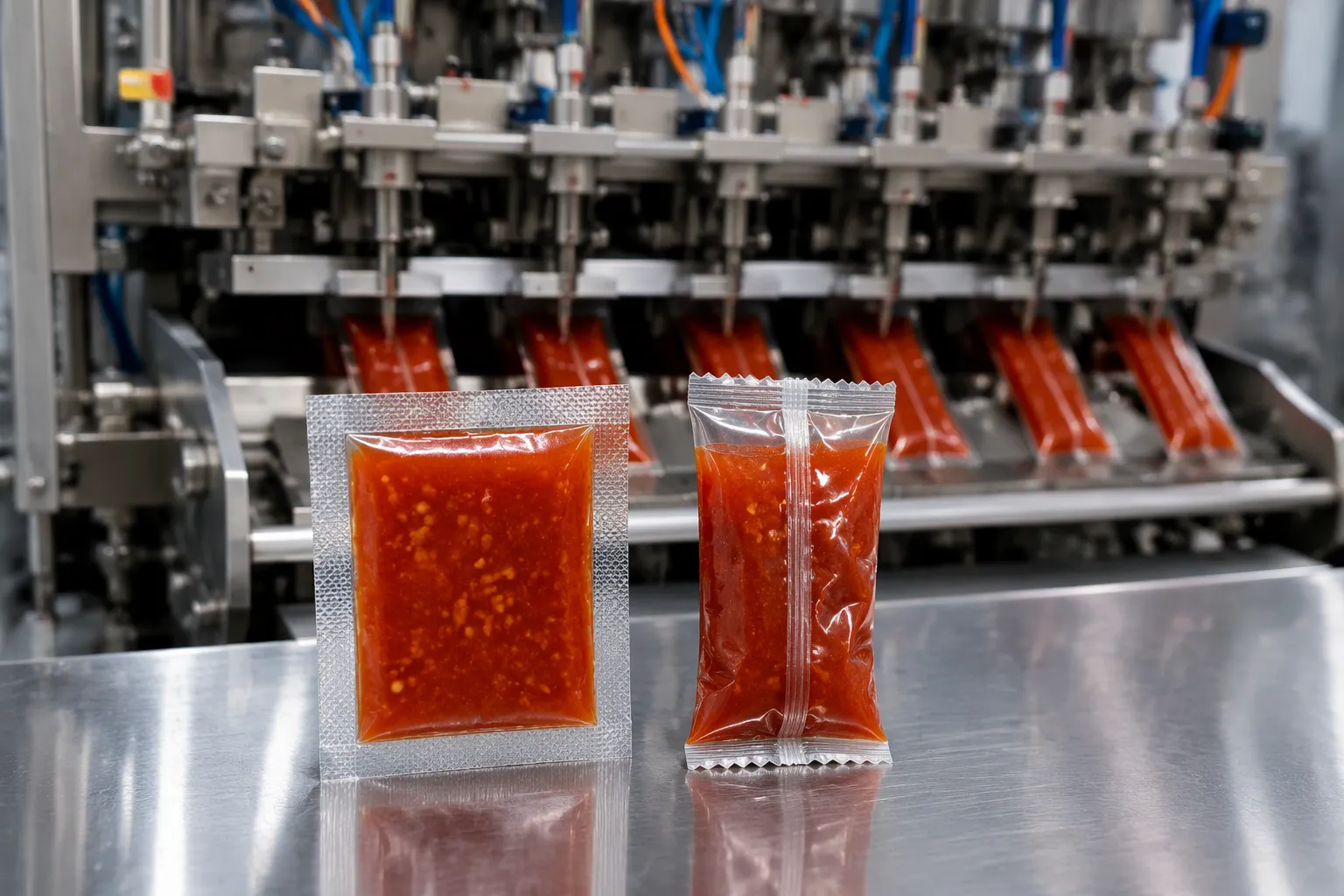
Seal strength under pressure is the clearest difference between the two formats. A back-seal bag has one vertical seam and two crimped ends. A four-side seal sachet has a bonded frame on every edge. That frame spreads stress across four borders instead of putting it all on one rear seam.
Thin liquids like soy sauce or vinegar flow easily and settle fast. Both formats handle them well. The risk of seal problems goes up when the product is oily or thick. Chili oil creeps into a seam during filling. Peanut butter pushes against the seal zone as the jaws close. A four side seal package traps the product inside a fully framed pocket. This makes contamination at the seam edge less likely.
Thick pastes also test the seal during handling and transport. Sachets stack, bend, and press against each other in a carton. A four-side seal sachet resists that pressure better. Its sealed border works like a reinforced rim. Back-seal bags still do well for basic rectangular portions. They just offer less margin when the sauce is dense or the fill volume is high.
Output depends on lane count and cycle timing. Four-side seal machines come in 2, 4, 6, 10, or 12 lanes. More lanes raise filling-line throughput without raising cycle speed. Each lane runs its own dosing cycle, so the machine fills several sachets per stroke.
Servo-driven film feeding keeps sealing quality consistent across every lane. The servo moves the web forward by a precise amount each cycle. Seal jaws and sealing rollers then close on the same spot every time. Consistent registration means consistent seal width. That consistency matters most on multi-lane machines, where one drifting lane can spoil a whole stroke.
Dosing accuracy also shapes output quality. A machine that overfills wastes film and product. A machine that underfills fails weight checks. Buyers should confirm the dosing system matches their sauce viscosity before comparing speed figures.
Format | Leak Risk Profile | Best Output Fit |
|---|---|---|
Back seal | Good for thin sauces and basic portions | Moderate to high volume, simple bag style |
Four-side seal | Stronger for oily and thick products | High volume, premium neat portions |
Choose back seal when the sauce is thin, the budget is tight, and basic rectangular sachets meet the brief. Choose four-side seal when leak risk matters, the product is viscous, and the line must run many lanes at steady speed.
How the product acts matters more than the machine type when picking a format. Ketchup and soy sauce flow easily, so a back-seal bag works well for them. Chili oil and cooking oil slip into seams during filling, and a four side seal package holds them inside a sealed pocket. Peanut butter and thick pastes press hard on the seal zone, so the stronger border of a four-side sachet gives extra safety.
Buyers who pack many kinds of sauces and condiments often run both formats together. Thin liquids like vinegar work with either machine. Thick pastes do better with the four-edge build. Neither format fails on these products; each one just fits a different thickness range.
Shape follows seal layout. A back-seal machine makes a basic rectangular sachet with a clear front panel. A four-side machine seals the pouch on all edges, so print area gets a little smaller at the borders. Fill volume ranges overlap a lot between the two formats, and the dosing system sets the real limit more than the bag style does.
Feature | Back Seal | Four-Side Seal |
|---|---|---|
Finished shape | Rectangular, one rear seam | Compact, framed on four edges |
Printable area | Full front panel | Front panel minus border bands |
Tear-notch position | Near top seal, clear of rear seam | On a side seal band |
Film roll spec | Single web, moderate stiffness | Dual webs, matched sealant layers |
Four-side machines fit products that need neat, compact, leak-resistant single packages. Back seal fits basic rectangular sachets and keeps film sourcing simple. Buyers filling liquid unit doses at high counts should weigh film cost against leak risk. Small liquid doses in premium portions often justify the framed look.
Buyers should check three compliance points before ordering any sauce sachet machine. First, ask for food-contact material certification on every part that touches the product. The certificate should cover the fill nozzle, the forming tube, and the seal jaws. Second, check the machine's hygienic design. Smooth stainless surfaces, rounded corners, and no exposed threads make cleaning easier. Third, inspect the filling zone. It should open for daily washdown without tools. A machine that traps sauce residue in crevices creates a real food-safety risk over time.
These checks apply equally to back-seal and four-side-seal models. Neither format has a compliance advantage by design. The difference lies in how each machine handles film and product contact during the sealing cycle. Buyers should request a hygiene audit checklist from the supplier and verify each point on the factory floor.
Film structure interacts directly with the sealing method. A back-seal machine uses one web. The vertical jaw presses the film's sealant layer against itself. The sealant layer must activate at the jaw's temperature and bond cleanly under pressure. Film stiffness matters too. A web that is too soft wrinkles at the former. A web that is too stiff cracks at the fold.
Four-side machines use two opposed webs. Four-edge sealing rollers bond the sealant layers along every border. Both webs must match in thickness and sealant composition. A mismatch causes uneven sealing and weak corners. Buyers should confirm film thickness and sealant layer specs with both the film supplier and the machine maker before production.
Film Property | Back Seal | Four-Side Seal |
|---|---|---|
Web count | Single | Dual, matched pair |
Sealant layer | Bonds to itself at vertical jaw | Bonds web-to-web at all edges |
Stiffness | Moderate, folds cleanly | Matched pair, resists wrinkling |
The number of lanes sets the base price of any filling packing machine. A 2-lane unit costs much less than a 12-lane unit. Every extra lane adds a dosing station, a set of seal tooling, and more control hardware. Buyers pay for more capacity at once, not for a fancier bag style.
Servo systems also raise the price. Servo-driven film feeding and sealing keep registration steady across many lanes. That precision costs a real premium over mechanical drive systems. Tooling adds another layer. Back-seal machines use simple vertical jaws and a tube former. Four-side machines need matched sealing rollers and dual-web handling. Changeover parts for bag style differ too. Four-side tooling sets cost more and have more pieces.
Film waste acts differently on each format. A back-seal machine runs one web, so startup trim stays small. A four-side machine runs two webs. Both must line up before the first good sachet appears, so startup waste runs higher. Changeover time follows the same pattern. Back-seal swaps involve a former and jaw set. Four-side swaps involve roller sets and web alignment on both sides.
Routine maintenance stays light on both formats. Jaws and rollers wear at about the same rate under normal duty. Four-side machines have more sealing surfaces to inspect, so daily checks take longer. Lower film waste and faster changeover cut the cost per dose on back-seal lines. Four-side lines make up for that gap with fewer leakers and less product loss.
Choose back seal when budget and simple operation lead the decision. Choose four-side seal when production scale justifies the higher investment.
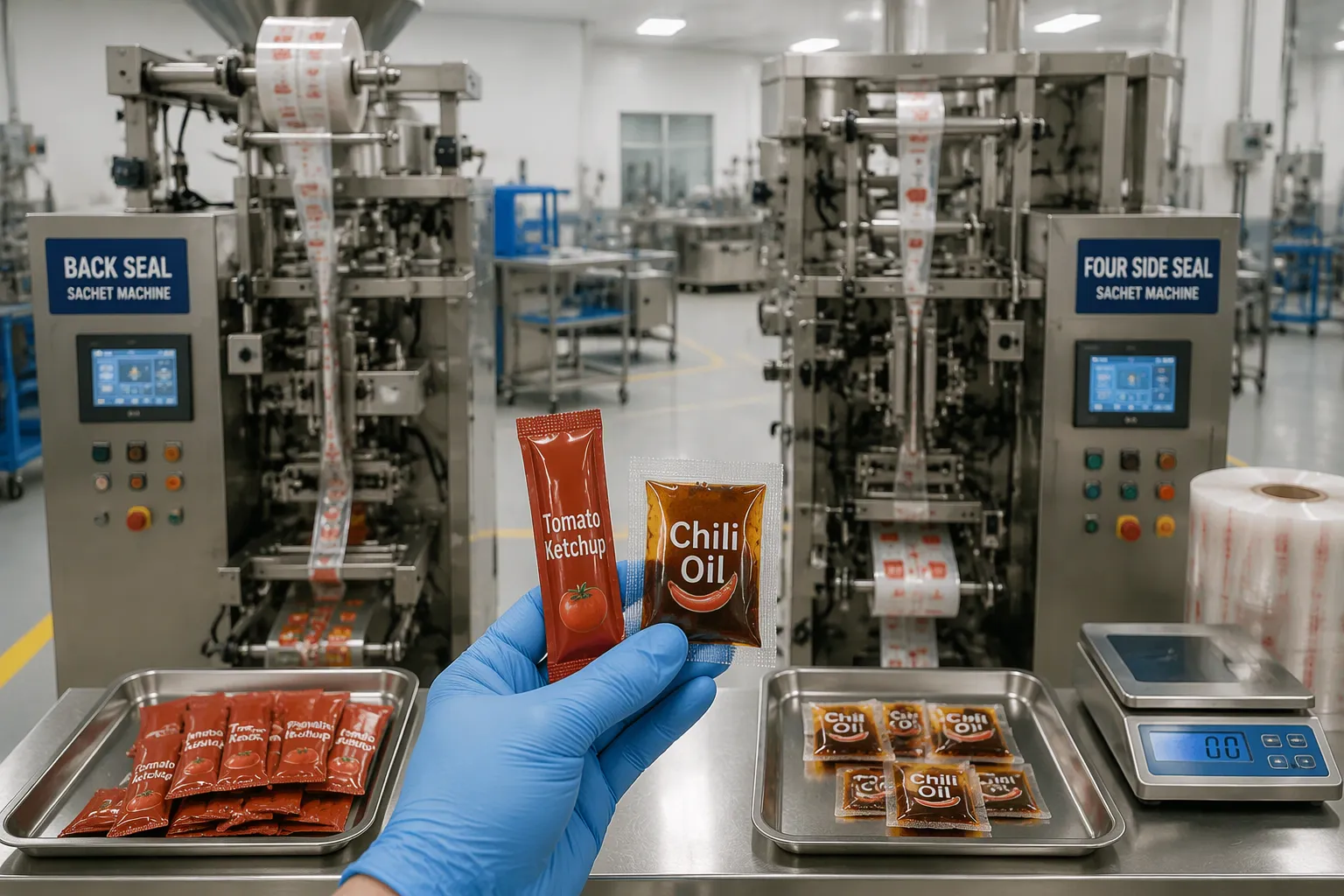
A back-seal line fits buyers who pack thin sauces in basic rectangular sachets. Ketchup, soy sauce, and vinegar flow well through a single-web former. The machine needs fewer tooling parts, and startup film waste stays low. Budget-minded buyers get a filling packing machine that covers the job without extra complexity. Pick this format when the bag style is simple, the fill volume is modest, and the target output sits in the moderate range. A small team can run it, clean it, and change it over without special training.
A four-side line fits buyers who pack oily or thick products. Chili oil, peanut butter, and dense pastes press hard on every seam. The framed pouch spreads that stress across four borders. The finished sachet also looks neater on shelf, and the compact shape suits premium portions. Pick this format when leak risk drives the decision, the fill volume is small and precise, and the target output runs high across many lanes. The higher price buys fewer leakers and less product loss over the machine's life.
A spec sheet cannot predict how a real sauce behaves inside a real film. Buyers should send samples of their actual product and their intended roll film to the supplier. The supplier then runs a trial on the proposed machine. Three checks matter most.
Fill accuracy: weigh a run of finished sachets and compare each one against the target dose. Ask for the spread, not just the average.
Seal strength: pull and squeeze sachets after the trial, then repeat after a short storage period. Oily sauces often reveal weak seams only after they sit.
Film runnability: watch the web through the former at production speed. Wrinkles and print drift show up fast on a live run.
Ask for the trial sachets back. Store them, stack them, and open a few by hand. That simple test tells a buyer more than any brochure.
Criterion | Back Seal | Four-Side Seal |
|---|---|---|
Sauce type | Thin liquids, free-flowing sauces | Oily, thick, or dense pastes |
Bag style | Basic rectangular sachet | Compact framed pouch |
Fill volume | Modest, standard portions | Small, precise unit doses |
Target output | Moderate volume, fewer lanes | High volume, many lanes |
Run through the four rows in order. The first row that clearly points one way usually settles the choice. Buyers who still sit on the fence should weigh film cost against leak risk, then book a trial with their own sauce.
Back seal is the simpler, cheaper choice for basic sauce sachets. Four-side seal is stronger, looks better, and handles thick products well. Neither format is better overall.
The right pick depends on the buyer's sauce, bag style, fill volume, and target output. A thin ketchup portion and a thick chili oil dose seldom need the same machine.
Buyers can act now. Send sauce samples, sachet sizes, milliliters per sachet, and target output to the supplier. A matched filling packing machine recommendation and quote follows.
Yes. A back-seal machine folds one web into a tube and crimps the top and bottom. That leaves one rear seam and two sealed ends. The trade calls this a three-side seal sachet. The front panel stays clear for print.
They do. A back-seal machine runs a single web. A four-side machine runs two opposed webs. Both webs must match in thickness and sealant layer. Buyers should confirm film specs with the film supplier and the machine maker together.
Sometimes. A multi-lane VFFS platform can run four-side sachets for clear liquids such as vinegar. Most buyers still order a machine built for one style. Tooling sets differ, and a swap takes time. Confirm this option with the supplier before assuming it.
Changeover time depends on the tooling set. Back-seal swaps involve a former and a jaw set. Four-side swaps involve roller sets and web alignment on both sides. Four-side changeovers carry more parts, so they usually take longer. Ask the supplier for a measured figure.
Run the actual sauce on the actual film. Weigh finished sachets for fill accuracy and check the spread, not just the average. Squeeze and store samples, then recheck the seams. Watch the web at full speed for wrinkles and print drift.


