Investing in industrial packaging equipment requires significant capital. You face high operational stakes right from the start. A poorly chosen machine disrupts daily output. It can severely limit your overall manufacturing growth. Every facility operates under unique physical constraints. A generic approach to equipment procurement rarely succeeds. Over-specifying your equipment often leads to wasted budget. It creates unnecessary complexity on the factory floor. Conversely, under-specifying creates immediate production bottlenecks. It also leads to continuous maintenance nightmares. You need a reliable method to balance capacity against actual production needs. This article provides a rigorous, vendor-agnostic framework for evaluation. It helps you assess an
Automatic Packing Machine accurately. We explore critical specifications regarding sustainable performance and mechanical integration. You will learn how to measure true throughput. We also cover how to assess material compatibility and confirm facility readiness. Finally, we examine control system standards and essential safety compliance mandates.
Key Takeaways
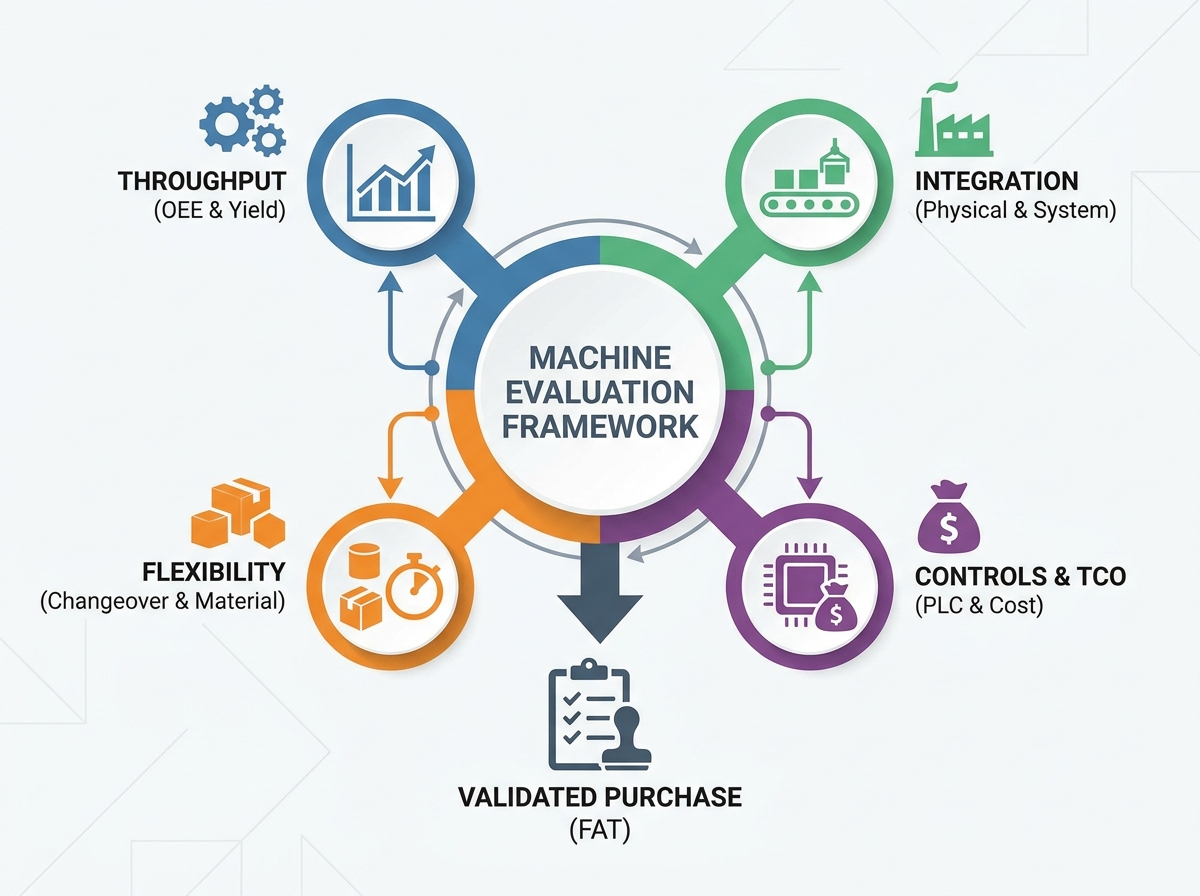
- Speed is secondary to OEE: Maximum cycles per minute mean little without factoring in Overall Equipment Effectiveness, changeover times, and maintenance intervals.
- Integration dictates success: A machine must align with existing upstream feeds, downstream logistics, and factory floor spatial constraints.
- Standardized controls reduce long-term expenses: Opting for universally recognized PLCs (e.g., Siemens, Allen-Bradley) prevents vendor lock-in and reduces software troubleshooting costs.
- Demand a Factory Acceptance Test (FAT): Never finalize a purchase without validating the machine's performance on your exact product and packaging material.
1. Throughput Capacity vs. Sustainable Yield
Manufacturers routinely advertise impressive maximum mechanical speeds. They measure these rates in cycles per minute (CPM). However, rated speed rarely matches operational reality. A machine running at absolute maximum speed often experiences accelerated wear. It also creates a higher probability of material jams. You must distinguish between theoretical peak performance and sustainable production speed. Sustainable yield accounts for micro-stops and routine maintenance. Micro-stops occur when sensors detect tiny faults. Operators must clear minor jams constantly. These small delays destroy Overall Equipment Effectiveness (OEE). Sustainable yield provides a highly accurate picture of your true daily output. Next, evaluate upstream surge capacity. Production lines rarely feed products at a perfectly uniform rate. Upstream equipment often pushes sudden surges of material. An optimal packaging system must handle these fluctuations seamlessly. It should feature intelligent buffering systems. An accumulation conveyor provides a physical buffer zone. This zone holds products temporarily while downstream machinery catches up. These buffers absorb product surges. They prevent catastrophic jams. They eliminate the need for sudden manual intervention. Evaluating this surge response ensures continuous operation during peak feeding moments. Finally, scrutinize reject rates and overall yield. High speed means nothing if accuracy suffers. You must look for specifications detailing acceptable error margins. Review the automated reject mechanisms carefully. Reject mechanisms utilize precise air blasts or mechanical diverter arms. They remove defective packages without stopping the entire line. Consider a practical scenario regarding yield profitability. A machine running at 99% accuracy at 100 CPM generates steady revenue. It minimizes wasted product. Conversely, a machine operating at 94% accuracy at 120 CPM creates massive waste. It drives up material costs significantly. Slower, highly accurate equipment always outperforms faster, error-prone alternatives.
2. Material Compatibility and Changeover Agility
Material tolerances directly impact production reliability. You must rigorously assess specifications for film thickness. Evaluate carton board grades and pouch rigidity. Thin films often suffer from burn-through during the heat sealing phase. Conversely, overly thick materials require longer dwell times. Warped corrugated boards easily jam in automated magazines. Many companies now transition to sustainable or recycled materials. These eco-friendly materials often display higher structural variance. A rigid machine struggles processing inconsistent recycled films. Determine if the equipment features adaptive tension controls. These controls accommodate slight material imperfections seamlessly. Toolless changeovers are absolutely critical today. Most facilities run multiple SKUs across a single shift. Extended changeover times destroy operational efficiency. Evaluate the exact minutes required to switch packaging formats. You should prioritize motorized or toolless changeovers over manual adjustments. Servo-driven adjustments automatically move components into exact positions. Requiring operators to use wrenches invites human error. It extends downtime needlessly. It also introduces inconsistencies between different machine operators. Here are key operational practices for managing fast changeovers:
- Pre-program format recipes: Utilize the control panel to store specific SKU parameters automatically.
- Implement quick-release mechanisms: Replace traditional bolts by using color-coded, snap-in locking levers.
- Standardize guide rails: Use motorized guide rails automatically adjusting to pre-set widths.
- Conduct visual verifications: Provide operators clear visual indicators confirming locked changeover points.
Scrap and waste metrics demand close attention. Review the manufacturer's data on material waste during specific phases. Machines often waste significant film during startup sequences. Stopping the machine also generates scrap. Changeover phases are notoriously wasteful. You must select equipment minimizing this transitional waste. An efficient system tracks and reports scrap metrics constantly.
3. Footprint, Layout, and Mechanical Integration
Integrating new equipment requires precise spatial planning. You must analyze the exact footprint requirements closely. A machine needs far more space than its base dimensions suggest. You must calculate necessary clearance for operator access. Heavy film rolls require dedicated lifting equipment. Forklifts need sufficient turning radiuses near the machine. Maintenance teams require wide pathways to open service doors fully. Safety guarding also expands the overall spatial envelope. Neglecting these clearances creates hazardous, cramped working conditions. Infeed and outfeed elevations represent another common integration trap. You must verify exact conveyor heights. They must match your existing production lines perfectly. Misaligned elevations force you to build custom mechanical transitions. Sometimes they require expensive inclined elevators. These custom additions increase budget demands quickly. They also introduce new points of mechanical failure. Documenting utility requirements prevents costly facility upgrades later. You must confirm specific electrical demands immediately. Document the required voltage, phase, and total amperage. Older facilities often lack modern high-amperage panels. Dropping a new machine into an outdated electrical grid causes frequent tripped breakers. Voltage drops force PLCs to reboot unexpectedly. This ruins production batches immediately. Pneumatic demands also require strict verification. Note the exact cubic feet per minute (CFM) and pressure (PSI) needed. If your facility infrastructure cannot support the machine, upgrade costs multiply rapidly.
Utility and Spatial Specifications Checklist
| Specification Category | Critical Metrics to Verify | Integration Impact |
| Spatial Layout | Base footprint, door swings, safety zones | Ensures safe operator access and compliant maintenance space |
| Line Elevations | Infeed height, outfeed height, adjustability | Eliminates custom conveyors and reduces material blockages |
| Electrical Power | Voltage, Phase (3-phase vs single), Amperage | Prevents panel overloads and costly substation upgrades |
| Pneumatic Supply | Required CFM, Operating PSI, Air quality | Ensures consistent actuator performance without compressor strain |
4. Control Systems, HMI, and Data Automation
Evaluating the Programmable Logic Controller (PLC) is non-negotiable. You must insist on open-architecture systems. Standardizing on non-proprietary systems yields significant advantages. Brands like Allen-Bradley, Siemens, or Omron are universally recognized. Local technicians can easily service these standardized platforms. Proprietary controllers lock you into the manufacturer's exclusive service network. Proprietary software requires expensive licensing fees. You must wait days for a specialized technician to arrive. Open-architecture platforms empower your internal maintenance team. They can troubleshoot logic issues immediately. This prevents minor software glitches from causing extended downtime. The Human-Machine Interface (HMI) directly dictates operator efficiency. A modern interface should feature highly intuitive diagnostics. Visual fault tracking allows operators to resolve minor jams instantly. Visual fault tracking displays exact sensor locations on a 3D machine rendering. Multi-language support helps diverse workforces operate equipment safely. A complicated HMI frustrates new employees. It dramatically increases required operator training time. Choose screens utilizing clear graphics rather than text-heavy menus. Industry 4.0 connectivity drives modern manufacturing intelligence. An advanced
Automatic Packing Machine must communicate effortlessly. Look for strict PackML compliance. This standard ensures consistent machine state reporting. PackML categorizes machine states universally. Terms like Idle, Execute, or Held mean the same thing across all your lines. Evaluate compatibility using Ethernet/IP or OPC UA protocols. These communication frameworks allow seamless data extraction. They feed real-time performance data directly into your ERP systems. They also connect to SCADA networks for predictive maintenance modeling.
5. Compliance, Safety, and Environmental Ratings
Environmental ratings determine where you can safely install equipment. For food, beverage, or pharmaceutical applications, you must specify required washdown ratings. An IP65 rating handles low-pressure water jets safely. However, rigorous sanitation protocols require IP69K certification. Food processing environments utilize harsh cleaning chemicals. Caustic foaming agents destroy standard aluminum components quickly. IP69K withstands high-pressure, high-temperature caustic washdowns. IP69K enclosures feature sloped roofs. These roofs shed water rapidly during sanitation. You must also specify appropriate stainless-steel grades. Standard 304 stainless works for general applications. Corrosive environments demand superior 316L stainless steel. Safety standards are absolute legal requirements. They are never optional upgrades. You must confirm strict compliance regarding regional safety directives. Equipment destined for Europe requires a legitimate CE mark. North American installations demand UL or CSA certification. Ensure the design meets all applicable OSHA standards locally. Ignoring these certifications invites severe regulatory fines. It also exposes operators to unacceptable workplace risks. Guarding and safety interlocks require thorough physical inspection. Evaluate the machine's primary safety features rigorously. Category 4 safety circuits utilize redundant wiring. If one safety relay fails, the backup relay stops the machine safely.
- Safety Interlocks: Verify the presence of Category 3 or 4 redundant interlocks on all access doors.
- Light Curtains: Ensure optical barriers guard open infeed zones automatically. Breaking this barrier triggers an immediate, controlled stop.
- Emergency Stops: Check strategic placement of E-stop buttons around the entire perimeter.
- Energy Isolation: Confirm easily accessible lockout/tagout (LOTO) points for maintenance crews.
Conclusion
Evaluating an industrial packaging solution requires a highly disciplined approach. You must look far past the glossy brochure speed claims. Focusing heavily on mechanical integration realities ensures long-term success. Changeover agility directly impacts your daily profitability. Lifecycle support considerations dictate future maintenance headaches. A strategic purchase balances immediate capacity against sustainable operational reliability. When integrating a new
Automatic Packing Machine into your existing workflow, prioritize standardization and worker safety above all else. Take these definitive next steps before signing any contract:
- Compile your exact operational needs into a formal User Requirement Specification (URS) document.
- Distribute this URS to multiple vendors to ensure standardized quoting.
- Evaluate proposed layouts against your actual factory floor measurements.
- Mandate a comprehensive Factory Acceptance Test (FAT) as a non-negotiable contract condition.
- Conduct the FAT using your actual product and production-grade film to guarantee performance.
FAQ
Q: What is a Factory Acceptance Test (FAT) for a packing machine?
A: A Factory Acceptance Test is a rigorous validation protocol. It takes place at the manufacturer’s facility before equipment ships. You run your actual product and packaging materials through the equipment. This process proves the machine meets all contracted specifications. It allows you to identify and fix defects before delivery.
Q: How do I calculate the ROI on an automatic packing machine?
A: You calculate ROI by comparing capital expenditure against comprehensive operational savings. Factor in substantially reduced labor costs. Add the financial benefit of increased output volume. Include savings from lowered material waste and minimized downtime. Project these accumulated savings over a standard 3- to 5-year depreciation schedule to determine payback periods.
Q: Should I buy a custom or standard automatic packing machine?
A: Standard models offer significantly faster lead times. They provide proven mechanical reliability and cheaper replacement parts. Custom machines carry higher risks and longer design phases. You should only pursue custom equipment for highly proprietary product shapes. They are also necessary for extreme spatial constraints standard frames cannot accommodate.


