
Views: 0 Author: Site Editor Publish Time: 2026-11-02 Origin: Site


The shift from manual or semi-automated packing to a fully automated system represents a critical pivot point for modern production facilities. It helps businesses scale operations while battling ongoing labor shortages and steadily rising packaging material costs. However, investing in an Automatic Packing Machine remains a major capital expenditure. You must carefully align mechanical capabilities with your facility’s specific workflow realities. Relying solely on raw speed metrics can lead to costly operational mismatches down the line.
This guide strips away common marketing claims to provide a clear, objective perspective. We will evaluate the essential features, realistic operational benefits, and actual implementation risks associated with industrial packing automation. By the end of this resource, you will understand exactly how to assess your baseline metrics, identify critical machine requirements, and select an automation partner capable of supporting your long-term growth.
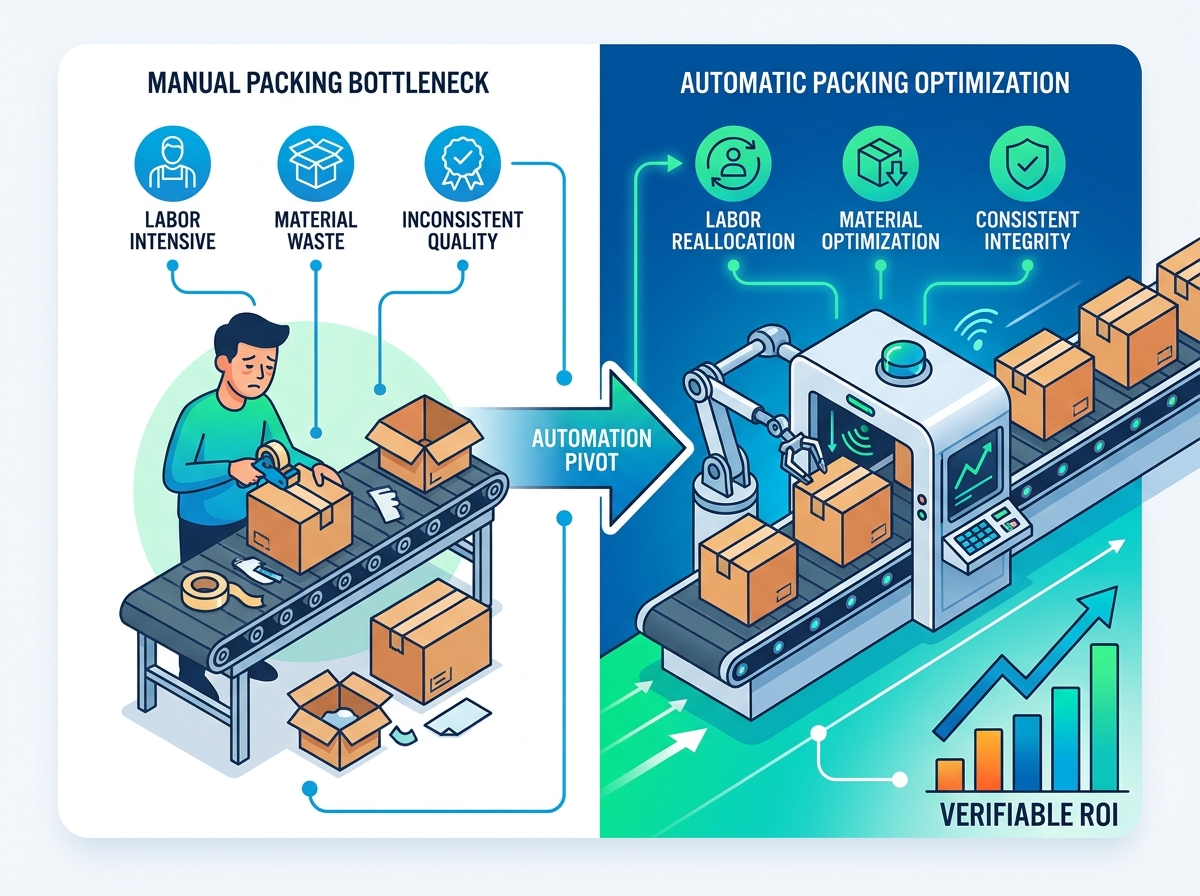
Many plant managers realize they need automation only after recognizing severe bottlenecks. You might notice pallets stacking up at the end of your production line. This congestion creates a ripple effect across the entire warehouse floor. Inconsistent packaging quality also drains resources. Manual packing often leads to poorly sized cartons, which drastically increases dimensional weight charges from freight carriers. To solve these business problems, you must first define your operational bottlenecks clearly.
Before purchasing equipment, you need to establish rigorous baseline metrics. A successful automation strategy relies heavily on understanding your current performance gaps. Conduct an internal audit focusing on three vital evaluation metrics:
Once you gather these metrics, you can define clear success criteria. Simply buying a machine does not guarantee success. You must define what a victorious deployment looks like for your specific facility. Industry best practices suggest aiming for at least 98% machine uptime. You should also target a minimum 15% reduction in consumable waste. Furthermore, a highly successful deployment allows you to double your production volume while achieving a zero increase in warehouse headcount.
Modern packaging automation offers a vast array of technical specifications. Wading through these options requires a focused approach. High maximum speeds sound impressive on paper. However, practical flexibility usually dictates the long-term viability of the equipment. When reviewing different models, you must evaluate features that directly impact daily uptime and ease of use.
Facilities rarely run a single product size continuously. High-mix environments require constant adjustments to accommodate different carton dimensions or product profiles. An advanced Automatic Packing Machine should feature tool-less changeovers. This capability allows floor operators to switch mechanical guides and sealing heads using quick-release levers rather than wrenches. Minimizing changeover downtime from thirty minutes to under five minutes drastically improves your Overall Equipment Effectiveness (OEE).
Quality assurance cannot rely solely on human visual inspection at high speeds. Modern machines integrate smart vision systems and photo-eye sensors directly into the line. These in-line QA components detect label misalignments, verify internal product counts, and identify barcode errors. If the system detects a defect, it automatically diverts the faulty package to a reject lane before final sealing. This prevents costly customer returns and protects your brand reputation.
A complex machine requires an intuitive control panel. The HMI serves as the bridge between your warehouse staff and the automation software. Look for high-resolution touchscreen controls featuring visual diagnostics. When a jam occurs, a well-designed HMI highlights the exact location of the fault on a 3D machine map. It provides step-by-step resolution prompts. This intuitive design empowers floor operators to resolve minor faults immediately. They no longer need to call specialized maintenance technicians for every minor stoppage.
Standalone machines create isolated data silos. Today, your packing equipment must communicate with your broader facility network. Programmable Logic Controller (PLC) compatibility is non-negotiable. Ensure the machine integrates seamlessly with your existing Warehouse Management System (WMS) or Enterprise Resource Planning (ERP) software. This connectivity enables real-time throughput tracking. It also triggers predictive maintenance alerts, warning you about component wear before a catastrophic breakdown halts production.
It is easy to fixate on the sheer speed of automated equipment. However, the most profound financial impacts often emerge from secondary benefits. Automation enforces a level of consistency that human operators simply cannot match. This consistency directly drives down waste and improves downstream logistics.
Manual packers often use excessive tape and wrap. They overcompensate to prevent transit damage. Automated systems eliminate this guesswork. For example, automated tension control in stretch wrappers stretches film to its exact yield point, drastically reducing film usage. Similarly, dynamic right-sizing technology in cartoners cuts corrugated cardboard to match the exact dimensions of the product inside. This systematic reduction in consumable usage generates massive savings compared to manual packing methods.
Packing stations represent high-risk areas for repetitive strain injuries. Manually erecting boxes, taping seams, and lifting packages leads to operator fatigue and workers' compensation claims. Automation removes human capital from these ergonomically hazardous tasks. You can then reallocate your workforce to higher-value roles. Former packers can transition into quality assurance, supervisory positions, or preventative maintenance roles. This shift improves overall employee retention and plant safety.
Inconsistent manual packing jeopardizes load integrity. A poorly sealed box can collapse under pallet pressure, damaging the goods inside. An automated system guarantees consistent sealing, precise wrapping, and rigid dimensional accuracy. This uniformity significantly reduces transit damage claims. Furthermore, standardized box sizes allow you to optimize pallet stacking patterns. Better pallet utilization translates directly to lower truckload costs and minimized dimensional weight penalties.
To justify the capital expenditure, you must build a verifiable ROI model using transparent assumptions. Do not rely on aggressive vendor estimates. Build a balanced calculation that weighs your upfront capital expenditure, ongoing maintenance, and energy usage against your projected labor and material savings. By calculating these variables accurately, most industrial facilities achieve a realistic payback period of 12 to 24 months.
Baseline Variables for ROI Calculation
| Financial Variable | Manual Packing Baseline | Automated Packing Projection |
|---|---|---|
| Labor Costs (Per Shift) | High (Multiple operators + Overtime) | Low (One supervisory operator) |
| Material Consumables | Variable (Prone to over-usage) | Optimized (Precision dispensing) |
| Freight Damage Claims | Moderate (Inconsistent load integrity) | Minimal (Standardized dimensions) |
| Maintenance Expenses | Low (Basic tools only) | Moderate (Preventative servicing) |
Purchasing the equipment is only the first step. The installation phase introduces significant operational risks. Failing to plan for the physical and technical realities of implementation can delay your project by months. You must proactively manage these adoption hurdles to ensure a smooth transition.
Industrial machinery demands substantial floor space. You must thoroughly assess your facility footprint before committing to a specific model. Measure not just the machine’s dimensions, but the operational clearances around it. Check ceiling height clearances for vertical components or elevated conveyors. Ensure your layout leaves adequate staging areas for raw materials. You must also map out safe forklift interaction zones to prevent collisions during material replenishment.
An automated packing line rarely operates in isolation. It must receive products from upstream conveyors and pass finished goods to downstream palletizers or labeling systems. Matching the speed of your new equipment with existing legacy machinery is notoriously complex. If your upstream feed is too slow, the packing machine starves. If downstream equipment bottlenecks, the packing machine faults. You must map these integration points meticulously to avoid continuous micro-stops that ruin efficiency.
Installation causes unavoidable disruption. You cannot simply drop a machine onto the floor and run it the next day. Preparing the site, installing the equipment, integrating data systems, and commissioning the line requires a complete production pause. You must account for this hidden cost. Mitigate this risk by building up buffer inventory before installation begins. Plan phased deployments during off-peak weekend hours whenever possible.
The most sophisticated machinery becomes useless if your team cannot operate it. Underestimating training requirements remains a common failure point. In-house staff often lack the mechanical knowledge or software fluency to keep modern systems running optimally. Demand comprehensive, hands-on training from your vendor. Maintenance teams need dedicated sessions on troubleshooting PLC faults, replacing wear parts, and executing preventative maintenance schedules. Operator confidence directly correlates with machine uptime.
Selecting the right machinery means selecting the right engineering partner. You are entering a long-term relationship with the manufacturer. Evaluating vendors strictly on baseline equipment capabilities often obscures long-term operational realities. You must look past the initial sales pitch to understand how the vendor will support your operation years after deployment.
Do not let the lowest upfront purchase price drive your final decision. You must evaluate the long-term utility costs associated with running the equipment. Look closely at the availability of replacement parts. Machines requiring expensive, proprietary parts often lead to severe supply chain delays when components break. Prioritize vendors who build their systems using off-the-shelf, widely available commercial components. Additionally, review their preventative maintenance contract fees upfront to ensure long-term budget predictability.
Vendor Evaluation Matrix
| Evaluation Criteria | Legacy Equipment Vendors | Advanced Automation Partners |
|---|---|---|
| Part Sourcing | Proprietary (High cost, long lead times) | Off-the-shelf (Accessible, cost-effective) |
| Changeover Style | Manual tool adjustments | Servo-driven, tool-less levers |
| Diagnostic Support | On-site technician required | Remote diagnostic access via PLC |
Never sign off on delivery without conducting a Factory Acceptance Test. The FAT is an absolute necessity. You must ship your specific products and actual packaging materials to the vendor’s site. Watch them run your materials through the machine under production-like conditions. This test exposes material incompatibilities, feeding jams, and software glitches before the machine ever reaches your floor. If a vendor hesitates to perform a rigorous FAT, consider it a major red flag.
When a machine goes down, every minute costs money. Assessing the vendor’s localized support infrastructure is critical. Review their Service Level Agreement (SLA) tiers carefully. Do they offer guaranteed emergency response times? Check the availability of local technicians in your region. Furthermore, prioritize partners who offer secure remote diagnostic capabilities. Many software faults or sensor misalignments can be resolved instantly by a remote engineer logging into the machine's PLC, saving you the cost and delay of an on-site visit.
Navigating the transition to automated packaging requires more than just capital. It requires a strategic alignment of mechanical capabilities, facility constraints, and workforce readiness. Remember, the best Automatic Packing Machine for your facility is not necessarily the one with the highest maximum speed. It is the machine that integrates seamlessly into your existing physical layout and data ecosystems while offering flexible changeovers to handle future product variations.
Your immediate next step should be data collection. Initiate a rigorous time-and-motion study of your current manual packing line to establish firm baselines. Document your material waste and throughput bottlenecks. Once your metrics are solid, reach out to shortlisted vendors and request application-specific case studies that mirror your industry and volume demands. Let hard data, rather than marketing brochures, guide your automation journey.
A: Typically, facilities see a return on investment within 12 to 24 months. This timeline depends heavily on your shift structure. Multi-shift operations realize faster ROI due to accelerated labor savings. Specific material savings, such as reduced film usage or optimized corrugated sizing, also shorten the payback period significantly.
A: Yes, but you must select the right equipment. High-mix environments require prioritizing machines equipped with robotic arms, dynamic right-sizing, or servo-driven tool-less changeovers. Avoid fixed-automation legacy models, as their lengthy manual changeover times will destroy your operational efficiency during frequent product swaps.
A: Disruption varies based on system complexity, ranging from a single weekend to several weeks. To mitigate production halts, you must develop a phased installation plan. Conducting a rigorous Factory Acceptance Test (FAT) beforehand prevents unexpected site delays. Furthermore, building up buffer inventory before installation helps bridge the integration period.


