
Views: 0 Author: Site Editor Publish Time: 2026-11-01 Origin: Site


Outgrowing manual packaging processes represents a common milestone for scaling businesses. Rising labor costs, quality inconsistencies, and higher production volume demands often force operational leaders to rethink their packaging lines. Transitioning to automated solutions requires a significant capital expenditure. However, this investment effectively shifts variable labor expenses into fixed, predictable operational efficiency.
Choosing the right equipment requires aligning material characteristics, throughput targets, and facility constraints long before you evaluate vendor specifications. Navigating the equipment market can feel overwhelming without a clear strategy. You must balance current production needs against future scalability.
This article provides a structured evaluation framework to guide your decision-making process. We will help you shortlist the correct machinery, assess facility limits, and calculate realistic ROI. Read on to discover how to match your physical product realities with your business growth targets.
You must first define the physical state of your product before looking at machine catalogs. We categorize products into four main types based on how they move. Free-flowing items include beans, rice, and seeds. They drop easily under gravity. Non-free-flowing items include baking powder and flour. These tend to clump or bridge together. Liquids range from pure water to thick, viscous syrups. Fragile items include baked goods and delicate snacks which break easily.
These flow characteristics directly dictate the filling mechanism you need. Powders typically require auger fillers. These screw-like mechanisms prevent airborne dust and ensure high accuracy. When handling granular products, an Automatic Packing Machine equipped with a multi-head weigher ensures precise dosing. Liquids need piston fillers or peristaltic pumps for exact volume control. Matching your product's flow behavior to the correct dosing head prevents product damage and maintains consistent weight accuracy across shifts.
Next, map your product to the final packaging format. Common formats include traditional pillow bags, stand-up pouches, vacuum-sealed bags, and rigid containers. Each format serves a different market need. Stand-up pouches dominate premium retail shelves due to their billboard effect. Pillow bags offer cost-effective solutions for bulk snacks.
You must highlight future flexibility during this planning stage. Altering packaging formats later requires significant machine flexibility. You will need tool-less changeovers or entirely different equipment if you switch from pillow bags to stand-up pouches. A machine designed exclusively for narrow pillow bags cannot magically produce wide, gusseted pouches. Plan your packaging roadmap early. This foresight prevents costly equipment replacements down the line.
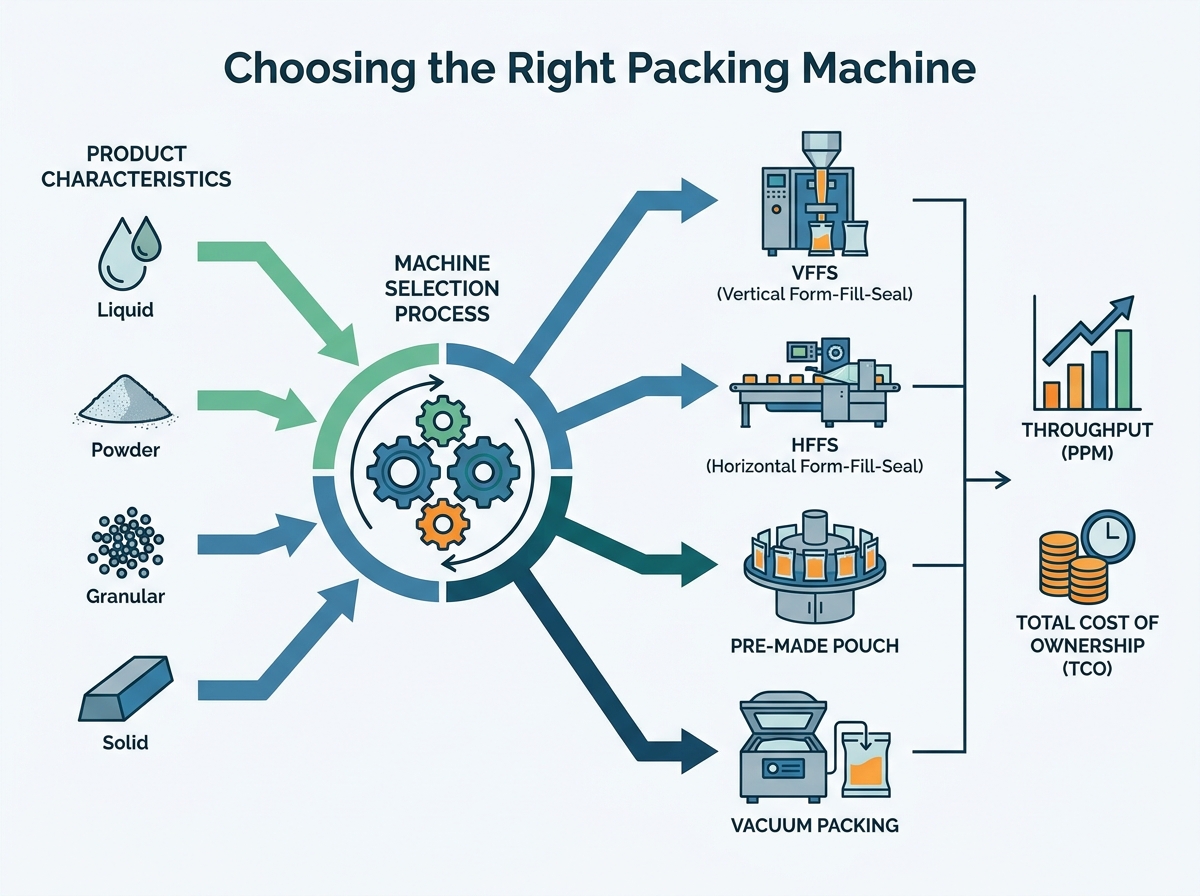
Form-Fill-Seal technology dominates the flexible packaging industry. Vertical Form-Fill-Seal (VFFS) machines are best for loose, granular, or powder products. They prioritize high speed and require lower floor space. Gravity feeds the product downward into the newly formed bag. These machines pull flat roll-stock film over a forming tube, seal the bottom, drop the product, and seal the top.
Horizontal Form-Fill-Seal (HFFS) machines operate differently. They are optimal for solid, single items like protein bars, medical devices, or plastic trays. These products require precise orientation inside the package. HFFS systems move the film horizontally along a conveyor. They wrap the film around the product before creating the final seals. Choose HFFS when product orientation matters more than vertical gravity feeding.
Pre-made pouch packing machines cater to premium brand aesthetics. They handle complex bag designs like stand-up pouches, flat-bottom bags, and zipper closures. Marketing teams love them because they create beautiful retail presentations. These machines pick up an empty, pre-made pouch, open it, fill it, and seal it.
There is a notable trade-off here. You face a higher material cost per bag compared to the flat roll-stock film used in VFFS systems. However, pre-made pouch machines offer lower scrap rates and faster setup times. They provide excellent flexibility for short production runs. If you pack high-margin goods like specialty coffee or organic snacks, the premium aesthetic usually justifies the higher bag cost.
Automatic vacuum packing machines are essential for extending product shelf life. They remove oxygen to preserve perishables like fresh meat, cheese, and dairy. They also reduce package volume dramatically for items like textiles and pillows, saving shipping costs.
When evaluating these machines, focus on two main criteria. First, check the vacuum pump capacity. The pump size determines the evacuation speed and your overall cycle time. Second, measure the seal bar dimensions. The seal bar must accommodate your largest product size comfortably. Consider adding gas flush features if your product crushes easily under pure vacuum pressure.
Automated filling and dosing machines focus heavily on rigid containers. They move liquid or powder lines into bottles, jars, or metal cans. These systems handle high volumes efficiently and maintain clean production environments.
Key integration is critical for these lines. The filling machine must sync perfectly with automated capping and labeling equipment downstream. Any mismatch in conveyor speed causes bottlenecks. It reduces overall line efficiency and leads to container tipping. Ensure your vendor provides seamless communication protocols between the filler and downstream stations.
Packaging Machine Types Comparison
| Machine Category | Best Suited For | Primary Advantage | Main Trade-off |
|---|---|---|---|
| Vertical Form-Fill-Seal (VFFS) | Loose granules, powders, snacks | High speed, minimal floor footprint | Limited primarily to flexible film bags |
| Horizontal Form-Fill-Seal (HFFS) | Solid single items (bars, trays) | Precise product orientation control | Requires significantly larger floor space |
| Pre-made Pouch Machines | Premium stand-up pouches, zippers | Excellent retail shelf aesthetics | Higher per-bag material costs |
| Vacuum Packing Machines | Perishables, bulky textiles | Extended product shelf life | Slower overall cycle times |
We strongly warn against buying equipment based solely on "maximum speed." Vendors often advertise peak Packages Per Minute (PPM) under ideal, uninterrupted conditions. Real-world production lines rarely sustain these peak numbers over an eight-hour shift.
Instead, calculate your requirements based on Overall Equipment Effectiveness (OEE). OEE accounts for machine availability, performance speed, and output quality. You must plan for sustained average throughput. Factor in routine maintenance, film roll changes, cleaning cycles, and operator breaks. A machine rated for 100 PPM might only average 75 PPM during a standard shift. Plan your capacity based on the realistic 75 PPM metric.
Identify your spatial constraints before signing any purchase orders. VFFS machines require significant ceiling height. The gravity-fed weighers sit high above the forming tube. Conversely, HFFS machines demand extensive floor space to accommodate long horizontal in-feed conveyors. Measure your facility carefully, including doorways and loading docks for installation.
Account for all necessary utilities. Check your required electrical phase and voltage to avoid expensive facility upgrades. Verify compressed air availability, volume, and pressure stability. If you operate in food safety environments, ensure the machine has IP65+ ratings. These ratings guarantee the electronics survive rigorous washdown procedures safely.
Assess the frequency of your SKU changes. High-mix, low-volume facilities face unique operational challenges. Frequent product changes or bag size adjustments can destroy daily throughput if changeovers take too long.
You need tool-less changeovers to maintain factory efficiency. Operators should adjust guide rails and forming tubes without wrenches. Look for recipe-saving Human-Machine Interface (HMI) panels. Operators can load saved parameters instantly from a touchscreen. This technology prevents prolonged downtime and reduces human error during mechanical setup.
Automation requires a substantial initial capital expenditure. However, you must quantify the reduction in manual labor hours to see the true value. Calculate the hourly wages, healthcare benefits, and overtime premiums saved. Furthermore, automation mitigates repetitive strain injuries. This lowers your workers' compensation claims and reduces staff turnover.
Model your payback period carefully. Mid-tier automation typically achieves a positive return on investment within 12 to 24 months. Once the machine pays for itself, the ongoing labor savings convert directly into increased profit margins. You transform unpredictable human labor into fixed, reliable mechanical output.
Analyze your film and material compatibility closely. Automation requires tighter tolerances on packaging materials than manual bagging. Cheap, inconsistent film often causes frequent jams, poor seals, and machine stops. Buying higher quality film sometimes costs more upfront but saves thousands in reduced downtime.
Factor in reduced product giveaway. Manual packing often leads to overfilling. Workers add extra product to ensure compliance with weight regulations. Precision automated dosing eliminates this excess giveaway. Saving just five grams per package yields massive financial returns when producing thousands of bags daily.
Do not ignore hidden maintenance expenses during your evaluation. Calculate the cost of proprietary replacement parts versus off-the-shelf components. Proprietary parts often carry high markups. They also suffer from long shipping lead times, extending your downtime.
We recommend machines utilizing standard Programmable Logic Controllers (PLCs) and commercial pneumatics. You can source standard components locally from industrial suppliers. This open-architecture approach minimizes unexpected downtime and keeps your annual maintenance budgets highly predictable.
Food and pharmaceutical industries demand strict regulatory compliance. You must evaluate the construction materials rigorously. Choose 304 or 316 stainless steel based on your product. Highly acidic or salty foods require 316 stainless steel for superior corrosion resistance.
Look for clean-in-place (CIP) capabilities. CIP systems automate the internal cleaning process, ensuring consistent hygiene without tearing the machine apart. Always verify that the equipment holds necessary FDA, CE, or UL certifications. Non-compliant machinery poses severe legal and operational risks to your business.
Operator safety remains non-negotiable on any production floor. Standard requirements include heavy-duty interlocked safety guarding. The machine must halt all moving parts immediately if a worker opens a safety door.
Ensure the presence of highly visible, accessible emergency stops around the equipment perimeter. The vendor must provide clear standard operating procedures (SOPs). Proper documentation empowers your team to operate and troubleshoot the machinery safely. Do not accept machinery with vague or poorly translated safety manuals.
Vendor support acts as a critical feature, not an optional afterthought. Draft a strict shortlisting criteria checklist for potential manufacturing partners.
Selecting the right automated packaging equipment is an exercise in matching physical product realities with your business growth targets. The cheapest initial price tag often yields the highest long-term operational costs if the machine causes bottlenecks or excessive downtime. By evaluating your product flow, facility constraints, and vendor support ecosystem, you can make a confident, data-driven investment.
To move forward effectively, follow these action-oriented next steps:
A: You can expect a realistic lifespan of 10 to 15 years with proper preventative maintenance. Heavy-duty mechanical components are highly durable. Obsolescence usually relates to software or PLC components rather than mechanical failure. Upgrading the electronic controls can often extend the machine's useful life even further.
A: This usually requires fundamentally different dosing heads. While the base pouching machine might be adaptable, swapping between an auger filler for powders and a piston filler for liquids is highly complex. It is rarely cost-effective to hybridize heavily due to extensive changeover times and severe cross-contamination risks.
A: The main difference lies in operator involvement. A semi-automatic machine requires human triggering or manual loading for every single cycle. In contrast, a fully automatic machine runs continuously. It handles everything from the bulk product feed to the finished, sealed package without manual intervention during the cycle.
A: Do not just look at the machine's base dimensions. You must account for vertical clearance, especially for the multi-head weigher mounted on top. Additionally, you need to plan for safe operating perimeters, maintenance access, and extra space for staging film rolls and finished product conveyors.


