
Views: 0 Author: Site Editor Publish Time: 2026-11-04 Origin: Site


Scaling production eventually breaks manual packaging processes. Facility leaders quickly hit a ceiling where human hands cannot keep pace. Operations managers must choose between constantly hiring temporary staff or finally investing in automation. This specific choice dictates your facility's future growth and overall profitability.
The transition from manual labor to machinery shifts your financial structure significantly. You replace unpredictable variable labor costs with fixed capital equipment investments. This move fundamentally changes your daily unit economics. It also redefines how you approach seasonal demand spikes and workforce management.
This guide breaks down operational realities and complex cost structures. We detail the specific throughput thresholds required to make an evidence-based decision. You will understand exactly when to stick with manual methods and when to upgrade your systems.
You cannot improve a process until you fully understand its baseline capabilities. Facilities usually operate in one of three distinct packaging tiers. Evaluating these tiers helps you identify operational bottlenecks.
Manual packaging relies entirely on human labor. Workers handle the measuring, filling, sealing, and labeling processes. This method offers incredible flexibility. You can switch box sizes or bag formats instantly. However, human workers experience fatigue. They make mistakes during long shifts. This repetitive motion also introduces serious ergonomic injury risks. Facilities often face high turnover rates in these demanding physical roles.
An Automatic Packing Machine performs continuous, minimal-intervention operations. These units include vertical form fill seal systems and automated pouch fillers. They handle high-speed, repeatable tasks effortlessly. You gain precise material handling and exact dosing. Machines do not tire out. They maintain identical cycle times throughout a twenty-four-hour shift. This consistency provides reliable production forecasting.
Many growing facilities start here. Semi-automatic packaging requires an operator to initiate the cycle. A worker might place an empty bag under a funnel. The machine then handles the precise filling and heat sealing. This approach blends human flexibility and machine precision. It serves as an excellent stepping stone for scaling businesses.
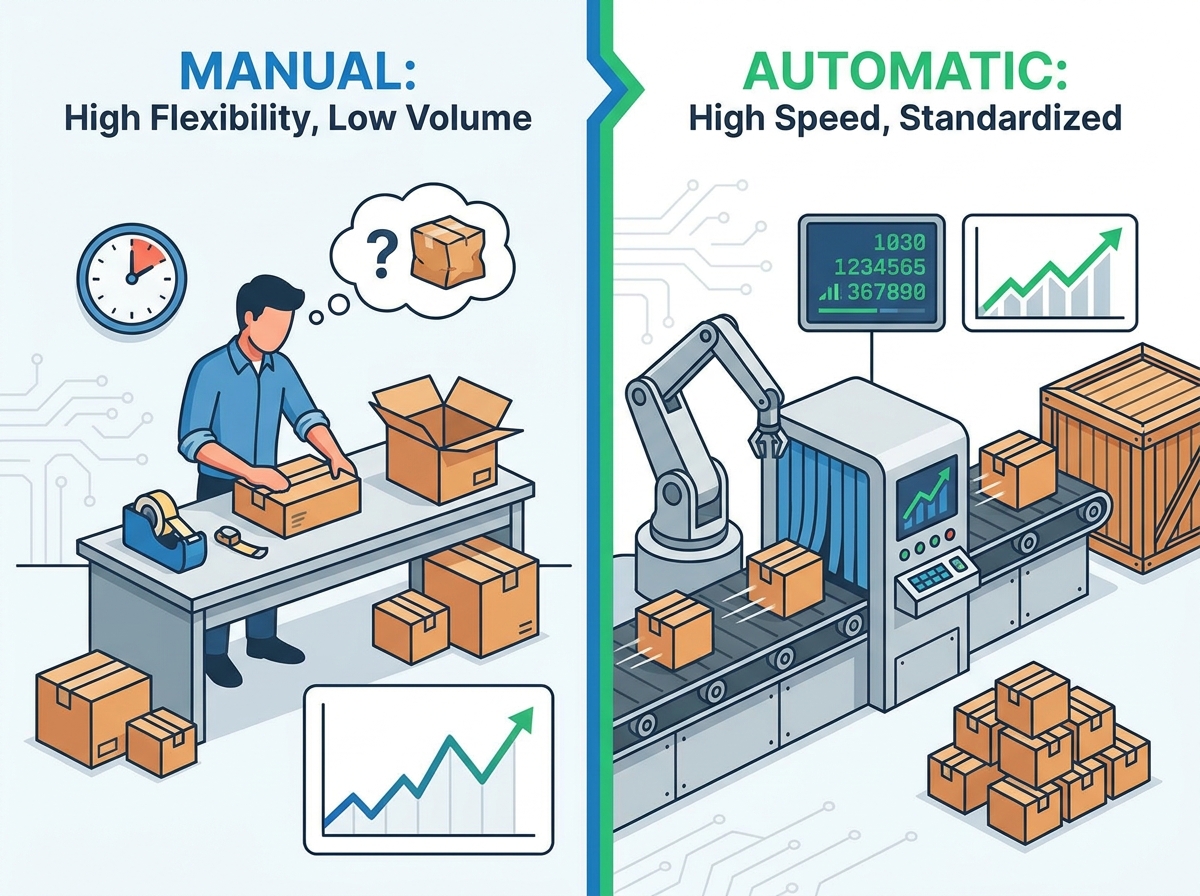
Financial evaluations often dictate packaging system choices. You must look beyond the initial purchase price. The true financial impact involves analyzing ongoing operational expenses against upfront capital.
Manual packaging requires almost zero upfront capital. You only need basic tables, digital scales, and simple hand sealers. This low barrier to entry appeals to startups. Conversely, automated systems demand significant capital expenditure. You must purchase the core machinery. You also pay for integration services and necessary facility modifications. Upgrading electrical drops or adding compressed air lines increases your initial spend.
Manual labor scales linearly. If you want to double your daily output, you must double your headcount. This reality increases your human resources overhead. You spend more time on recruitment, training, and managing worker schedules. Automation completely decouples production output from headcount. A single Automatic Packing Machine can replace several manual stations. This stability protects your margins during severe labor shortages or sudden peak seasons.
Cost Dynamics Comparison Matrix
| Financial Metric | Manual System | Automated System |
|---|---|---|
| Upfront Capital | Extremely Low | High |
| Labor Overhead | High (Scales Linearly) | Low (Decoupled Output) |
| Expense Type | Variable Operational | Fixed Capital |
| Output Predictability | Low (Fatigue Dependent) | High (Machine Governed) |
Timing your technology upgrade is crucial. Upgrading too early wastes capital. Upgrading too late chokes your overall revenue potential. You need specific metrics to justify this transition.
You must determine if packaging restricts your upstream production. Does your manufacturing line frequently pause? Production lines often wait for manual packagers to catch up. This delay indicates a clear bottleneck. When finished goods pile up before the boxing station, you are losing money. Measuring this staging area inventory provides clear upgrade signals.
Compare manual Units Per Minute (UPM) against machine specifications. A skilled worker might pack twenty bags per minute initially. However, human output drops steadily throughout a shift. Fatigue reduces afternoon production rates by up to thirty percent. Automated equipment maintains a perfectly flat efficiency curve. An Automatic Packing Machine running at sixty bags per minute delivers exactly that speed all day long.
Many businesses experience massive seasonal demand surges. Manual facilities must hire and train dozens of temporary workers. This onboarding process disrupts established workflows. Automated packaging machines offer highly predictable capacity scaling. You simply run the equipment for additional shifts. You avoid temporary hiring nightmares entirely.
Best Practice: Always request a live machine demonstration using your actual product. Testing your specific materials ensures the promised UPM matches real-world performance.
Speed represents only one automation benefit. Quality improvements often generate faster financial returns. Reducing errors directly improves your bottom line.
Manual measuring inherently causes material waste. Workers intentionally overfill packages slightly to avoid under-weight penalties. The industry calls this product "giveaway." Over time, giving away three extra grams per bag costs thousands of dollars. Automated systems utilize precise multi-head weighers and volumetric dosers. They eliminate giveaway entirely. You sell exactly what you package.
Consistent sealing prevents product spoilage. Hand-operated sealers depend on the worker's applied pressure and timing. This variability leads to weak seals or burnt plastic. Machines provide uniform seal pressure and exact temperatures. Stronger seals reduce transit damages and costly customer returns.
Strict compliance governs the food and pharmaceutical sectors. Automation limits human contact during production. Fewer hands on the product means lower contamination risks. Modern machines feature stainless steel washdown constructions. They simplify your FDA and regulatory compliance audits. We see compliance officers strongly prefer automated reporting logs over handwritten batch records.
Installing heavy machinery is not a simple plug-and-play event. Facilities must prepare for significant operational adjustments. Planning prevents expensive deployment delays.
An Automatic Packing Machine requires a dedicated footprint. You also need space for raw material staging and outfeed conveyors. Your facility might need utility upgrades. Most machines demand specific electrical voltages and clean, dry compressed air. Evaluating your current infrastructure prevents unexpected installation costs.
Common Mistake: Many operations managers forget to measure ceiling heights. Vertical packaging machines require significant overhead clearance for bulk product hoppers.
Automation thrives on standardization. If your facility runs twenty different bag sizes daily, automation might fail you. Changing forming tubes or adjusting sealing jaws takes time. Excessive mechanical changeovers reduce your Overall Equipment Effectiveness (OEE). The downtime required to retool the machine often negates its impressive running speed.
You must shift your workforce dynamic. You are transforming manual packers into technical machine operators. This transition requires comprehensive training. Your staff must learn basic troubleshooting and human-machine interface (HMI) navigation. It requires a deliberate shift in company culture. Workers often fear machines will steal their jobs. You must communicate how automation makes their daily tasks physically easier and safer.
Deciding between manual and automated processes requires honest operational assessment. You must align your current realities against your future goals.
Choosing between manual and automated packing involves more than raw speed metrics. It requires aligning your packaging capabilities directly to your broader business growth strategy. Manual processes offer unmatched flexibility for early-stage custom runs. However, automation becomes mandatory when standardized volume exceeds human physical limits. The transition replaces variable labor headaches with predictable, fixed-efficiency machine output.
Your next step requires gathering accurate data. Conduct a detailed time-and-motion study of your current manual packaging lines. Calculate your exact product giveaway costs. Request a comprehensive site audit from an equipment specialist. These actions will help you build a customized return-on-investment model. Stop guessing about your production limits and start planning your automated future today.
A: Typically, facilities see a full return on investment within 12 to 24 months. This timeline depends heavily on specific labor savings, reduced material waste, and increased throughput volume. Facilities running two or three daily shifts usually recover their capital expenditures much faster.
A: Yes, they can handle multiple sizes. However, switching sizes requires mechanical changeovers or digital HMI adjustments. Frequent daily changeovers create downtime. This downtime reduces your overall equipment effectiveness. We recommend standardizing bag sizes wherever possible.
A: Single-point-of-failure risk is a real operational threat. Facilities must maintain a strict preventative maintenance schedule. Keep critical spare parts on hand locally. You should also retain some basic manual packaging stations as a fallback capacity during unexpected outages.
A: Often, yes. Semi-automatic equipment balances lower capital expenditure with immediate improvements in consistency and speed. It serves as an ideal training ground. It helps mid-sized operations test automation concepts before committing to fully automated, high-speed lines.


