
Views: 0 Author: Site Editor Publish Time: 2026-11-03 Origin: Site


Finding transparent pricing for industrial packaging equipment remains notoriously difficult. Buyers frequently face vague quotes and hidden fees when searching for machinery. Scaling brands often struggle to decode complex technical proposals. This lack of clear pricing data frustrates operations managers ready to scale production lines. We want to transition you from simply asking about the sticker price. You need to understand exactly what drives these equipment costs. You must know how to calculate your true return on investment accurately. This guide breaks down the financial realities of automating your packaging workflow. We separate the initial capital expenditure from ongoing operational realities. You will learn realistic price ranges for different equipment categories. You will also discover the hidden variables inflating equipment quotes across the industry. By the end, you will possess a structured procurement framework. You can evaluate suppliers confidently and make informed purchasing decisions.
Baseline prices for a commercial automatic packing machine range from $10,000 for entry-level sachet models to $100,000+ for high-speed, integrated systems.
Production speed (pouches per minute) and automation levels are the two most significant drivers of base price.
Customizations for compliance (e.g., washdown environments, food safety) can increase initial costs by 20% to 40%.
You need clear financial expectations based on machine architecture. Arbitrary price tags rarely tell the whole story. We categorize these machines by function to help you set realistic budgets. Establishing a financial baseline prevents wasted time during supplier negotiations.
Price expectation ranges from $10,000 to $25,000. Startups and low-volume operations benefit most from these compact models. They handle simple powders or liquids ranging from 5 to 100 grams. You get a small footprint and straightforward operation. Operators require minimal technical training to run these units effectively. These machines typically use basic pneumatic cylinders for sealing jaws. They provide a highly cost-effective entry point into automated production.
Price expectation falls between $30,000 and $80,000. These units excel at high-speed bagging of bulk goods, snacks, and hardware. A roll of packaging film runs over a forming tube to create the bag vertically. Costs depend heavily on your chosen dosing system. Multi-head weighers cost significantly more than simple auger fillers. Integrating a robust Automatic Packing Machine into a vertical flow setup maximizes facility floor space efficiently. The vertical drop mechanism relies on gravity, ensuring fast and consistent product filling.
Price expectation starts at $40,000 and easily exceeds $120,000. Premium stand-up pouches, commonly known as Doypacks, require this specific technology. Consumers demand high-end aesthetics on retail shelves. These machines grab a pre-made bag, open it via vacuum suction, fill the product, and seal the top. They handle zipped bags and complex multi-step sealing processes effortlessly. Rotary configurations dominate this category, moving pouches through circular stations. The mechanical complexity of opening and handling empty pouches drives the higher price point.
Price expectation ranges from $25,000 to $75,000. Solid, single items require horizontal wrapping. Baked goods, plastic trays, and medical devices run perfectly on these systems. An infeed conveyor pushes the product into a continuous tube of film. Rotary sealing jaws then crimp and cut the film between each item. These machines offer incredible speed for solid products. Estimated Price Ranges by Packaging Technology
Machine Category | Price Range (USD) | Best Used For |
|---|---|---|
Entry-Level Sachet & Stick Pack | $10,000 – $25,000 | Startups, powders, liquids (5-100g) |
Vertical Form Fill Seal (VFFS) | $30,000 – $80,000 | Snacks, bulk goods, hardware |
Premade Pouch Filling | $40,000 – $120,000+ | Stand-up pouches, zipped bags |
Horizontal Form Fill Seal (HFFS) | $25,000 – $75,000 | Baked goods, medical devices, trays |
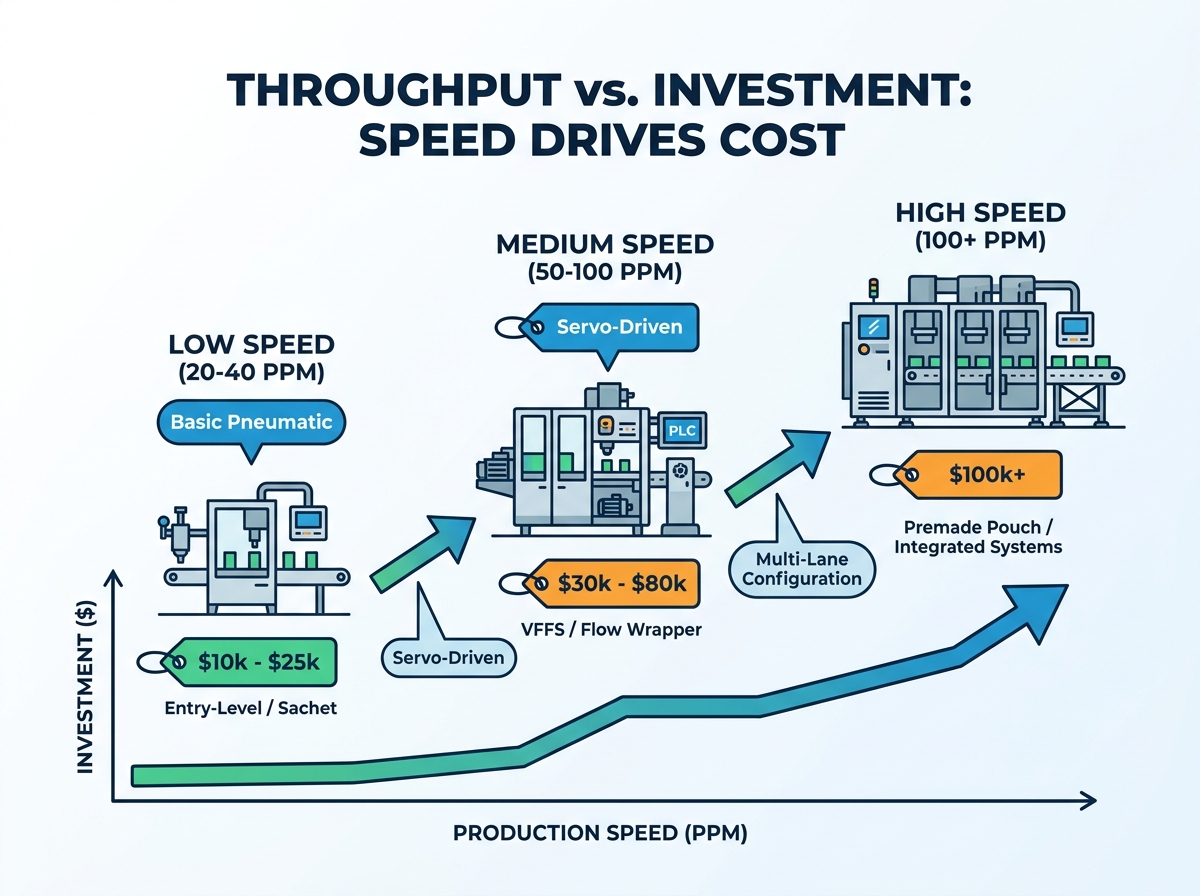
Production speed directly dictates machine cost. We see a strict linear relationship between pouches per minute (ppm) and the required engineering complexity. Faster machines demand more durable materials and advanced electronic controls to maintain accuracy.
These models utilize lower-cost pneumatics. Air compressors drive the mechanical movements of the sealing jaws. They feature single-lane operations. Businesses transitioning from manual to automated packaging find these units ideal. You keep initial capital expenditure very low. Maintenance remains simple because the internal components are mechanically straightforward.
Mechanical precision at these speeds requires servo-driven motors. Servo motors ensure mechanical longevity and highly consistent seal quality. You will notice a significant price jump here. Advanced Programmable Logic Controllers (PLCs) become mandatory to coordinate faster movements. Servo technology allows for programmable jaw pressure and highly accurate film pulling. This tier represents the sweet spot for growing mid-sized manufacturers.
Multi-lane configurations define this top tier. Continuous motion technology replaces intermittent stop-and-go sealing. The machine never pauses to seal the bag; sealing occurs while the film keeps moving. Robust vibration-dampening frames prevent mechanical fatigue at high velocities. You face the highest initial cost. However, you achieve the lowest cost-per-pack at maximum scale. Only massive production runs justify this level of capital investment.
Paying for 120 ppm wastes capital if your upstream product feeding cannot keep pace. Similarly, downstream cartoning equipment must handle the massive output. Align your machine speed to your overall line capacity. Buying excess capacity hurts your immediate return on investment. Always measure your current bottleneck before authorizing a high-speed purchase.
Hidden pricing factors cause quotes to vary wildly among suppliers. Two identical-looking machines often carry vastly different price tags. We deconstruct the variables affecting your final invoice. Understanding these elements prevents budget overruns.
Material Construction & Washdown Ratings: Upgrading from standard 304 stainless steel adds considerable cost. Acidic or corrosive products require premium 316 stainless steel to prevent rust. High-pressure washdown environments demand IP65 or IP69K electrical ratings. Engineers must seal every cabinet and motor against water ingress.
Dosing and Integration Complexity: The base machine frame only forms and seals the packaging film. Liquid pumps, volumetric cups, or highly sensitive multi-head weighers add distinct hardware expenses. A fully integrated Automatic Packing Machine costs significantly more than a bare-bones bagger. Weighing scales require highly calibrated load cells.
Changeover Flexibility: Tool-less changeover features cost more upfront. Operators can adjust bag widths using hand cranks instead of wrenches. Recipe-saving HMIs (Human-Machine Interfaces) also increase initial quotes. Co-packers handling multiple SKUs save thousands in labor downtime using these digital upgrades.
Regulatory Compliance: CE marks and UL certifications require rigorous electrical engineering. FDA-compliant contact parts demand specific material documentation and traceability. Ensuring compliance directly inflates manufacturing expenses. Builders must use approved food-grade plastics, lubricants, and welding techniques.
Custom Footprints: Facilities often have severely restricted ceilings. Legacy conveyors dictate strict integration heights. Modifying standard machine dimensions to fit your specific floor plan incurs custom engineering fees. Redesigning frames requires fresh CAD drawings and specialized fabrication.
Freight, Tariffs, and Installation: Suppliers frequently exclude these line items from initial quotes. Always factor in heavy freight shipping costs. Imported machinery incurs customs duties and port fees. Technician travel for onsite commissioning adds several thousand dollars to your final bill.
Securing accurate quotes requires a skeptical, structured approach. Vetting suppliers prevents costly procurement mistakes. You must standardize your request process to ensure vendor accountability.
Define the Scope Completely: Document your film specifications and product characteristics thoroughly. Provide bulk density measurements for powders or granules. Note your facility power supply limitations. Establish a target Overall Equipment Effectiveness (OEE) before requesting any quote. Provide suppliers with physical product samples early.
Demand a Factory Acceptance Test (FAT): Never sign off on the final payment prematurely. The manufacturer must run your specific product. They must use your exact roll of film. The equipment must achieve the agreed-upon speed at their facility first. You must witness this test in person or via live video.
Evaluate Service Level Agreements (SLAs): Look closely at remote diagnostics capabilities. Modern PLCs allow technicians to troubleshoot software bugs via secure internet connections. Check for a localized technician network. Compare warranty terms aggressively to ensure long-term reliability.
Compare Apples to Apples: Competing quotes often hide missing components. Create a spreadsheet checklist to verify equivalent safety guarding. Ensure both quotes include comparable spare parts kits. Verify integration hardware matches across all proposals. Never assume an accessory is included unless explicitly listed.
Investing in an automated packaging line represents a strategic operational decision. It is never a simple commodity purchase. The lowest upfront sticker price frequently leads to higher operational friction later. Inferior builds cause excessive downtime and frustrate operators. We recommend taking a calculated next step. Conduct an internal time-study characterizing your current manual packing bottlenecks. Determine exactly how many labor hours go into your current process. Establish a firm baseline ROI requirement before engaging any vendors. You will negotiate from a position of immense strength. This analytical approach ensures you select equipment perfectly matched to your distinct production goals.
A: Labor and manufacturing overhead differences primarily drive this gap. Component sourcing also plays a major role. Western brands typically use premium, localized PLCs and servos. Chinese manufacturers often utilize cost-effective domestic electronic components. The proximity of after-sales support networks and regional engineering wages further differentiate the final retail price.
A: Yes, equipment financing remains very common. Commercial lenders readily fund industrial machinery purchases. You secure better capital funding rates by demonstrating projected labor savings. A clear ROI calculation proves the equipment will pay for itself through increased daily efficiency.
A: Footprints vary drastically depending on the chosen technology. A single vertical unit might occupy just 4x4 feet of floor space. Conversely, a premade pouch line featuring inline multi-head weighers, platforms, and outfeed conveyors often requires 15x10 feet or more.
A: We typically see conservative benchmarks landing between 12 and 24 months. This timeline assumes you shift from three manual laborers to one machine operator. Running single-shift production yields steady returns. Adding a second shift accelerates your ROI timeline substantially.
A: The machine handles the physical packing perfectly. However, FBA compliance requires specific polybag thickness and precise barcode labeling. You must ensure the machine handles FBA-approved packaging materials. It must also integrate seamlessly alongside inline print-and-apply labelers to meet Amazon's strict inbound requirements.


