
Views: 0 Author: Site Editor Publish Time: 2026-06-26 Origin: Site


Stepping into decision-stage procurement carries exceptionally high stakes for modern food manufacturers. You face immense pressure to upgrade facility infrastructure without sacrificing daily output or product quality. Transitioning to automated packaging requires a delicate balance between throughput demands, strict food safety compliance, and fluctuating material expenses. A single mismatched specification can trigger disastrous line disruptions, chronic product giveaway, or widespread seal failures.
This guide outlines the objective, engineering-grade specifications you must evaluate to secure a rapid return on investment. We designed this framework to help you navigate complex vendor proposals and identify the exact mechanical requirements for your production environment. We emphasize how crucial it is to match mechanical configurations—such as weighing modules, sealing jaws, and material handling systems—to specific food properties like flowability, density, and fragility. You will learn how to align your packaging machinery with your long-term operational goals.
Base machine frame materials must meet minimum food-grade standards (SS304 or SS316), ideally utilizing fully welded tubular designs to eliminate bacterial harborage.
Drive mechanisms dictate long-term stability; servo-driven systems provide superior accuracy and lower maintenance compared to pure pneumatic setups.
Upstream dosing technology (multi-head weighers vs. augers) must be matched strictly to product flowability to prevent bridging or target weight deviations.
True production efficiency relies on seamless downstream handoffs, requiring PLC synchronization with an automatic case packing machine.
High-end specifications include "no-bag, no-fill" sensor protocols and MAP (Modified Atmosphere Packaging) capabilities to reduce waste and extend shelf life.
Inaccurate dosing quietly steals your profit margin through excessive product giveaway. Conversely, under-filling triggers severe compliance violations and rapidly degrades consumer trust. You need precise, reliable dosing mechanisms explicitly tailored to your product line. A machine can operate at incredible speeds, but if the upstream weighing module fails to portion the food accurately, the entire system becomes a liability.
You must evaluate dosing modules based on the exact physical state of your ingredients. Different food categories exhibit wildly different flow characteristics, necessitating highly specialized handling equipment.
Free-Flowing Solids: Snacks, nuts, and pet foods require multi-head weighers. These modules use target-weight algorithms to select the optimal combination of hoppers. They also need vibration-assisted feed pans to handle varying densities without crushing fragile pieces.
Powders and Particulates: Spices, flour, and protein mixes require servo-driven auger fillers. Airborne dust often contaminates the sealing zone. You must specify dust collection hoods and enclosed drop chutes to prevent microscopic particles from ruining your thermal seals.
Liquids and Viscous Goods: Sauces, oils, and pastes require specialized positive displacement pump systems. Anti-drip nozzles and suck-back valves prevent sticky residues from stringing across the bag opening.
Look for equipment guaranteeing micro-deviations in accuracy. Premium machines typically hold a ±1g precision tolerance, depending on the overall product volume. To sustain this accuracy over an eight-hour shift, the bagger should integrate seamlessly with a downstream check-weigher. Dynamic check-weighing feedback loops automatically tell the dosing module to adjust its fill parameters if trends drift toward the upper or lower control limits.
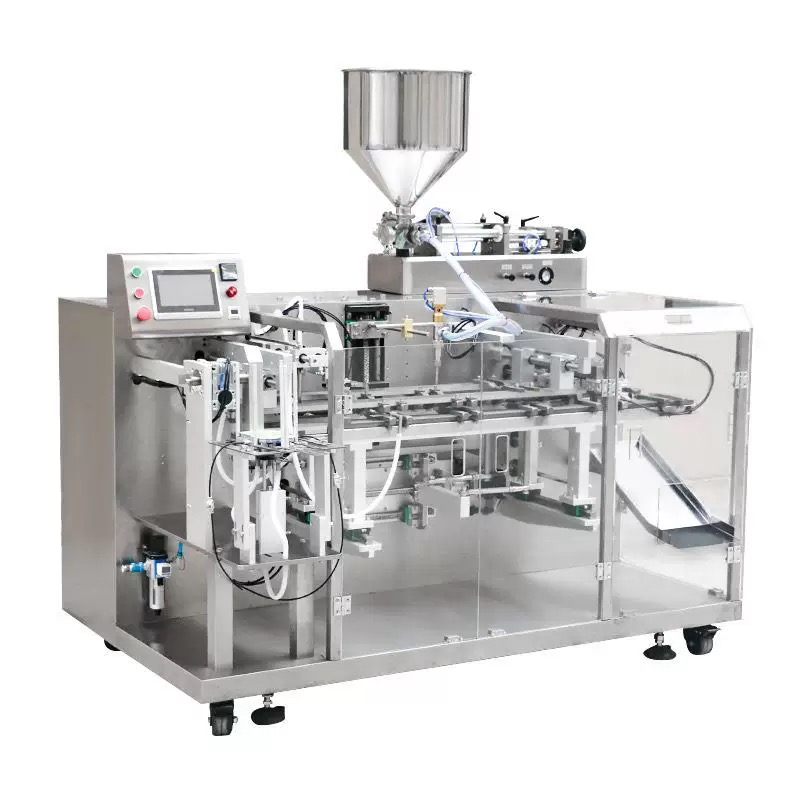
Evaluating the physical footprint and output capability of your bagging equipment determines your facility's operational cadence. You must choose between Vertical Form Fill Seal (VFFS) systems and premade pouch machines based on your product margins, required speed, and bag aesthetics.
VFFS systems form bags directly from a flat roll of flexible film. They are ideal for high-speed, single-SKU continuous production runs. You can typically expect outputs exceeding 100 bags per minute. Because they utilize raw rollstock, they offer the lowest consumable cost per unit. However, they struggle to produce complex, rigid bag shapes.
Premade pouch configurations work better for high-margin products demanding premium retail presentations. They handle distinct bag styles beautifully, including Doypacks, spouted pouches, and zippered formats. Because they open, fill, and seal pre-manufactured bags, their speeds typically range from 35 to 60 bags per minute.
Specification Feature | Vertical Form Fill Seal (VFFS) | Premade Pouch Machine |
|---|---|---|
Optimal Speed | 100+ bags per minute | 35 - 60 bags per minute |
Best Application | High-volume, single-SKU production | High-margin, multi-SKU retail products |
Bag Styles | Pillow bags, basic gussets | Doypacks, zippered, spouted, stand-up |
Consumable Cost | Very Low (Raw rollstock) | Moderate to High (Pre-converted bags) |
Your factory's spatial constraints also dictate the machine layout. Rotary layouts maximize floor space by utilizing a circular, 8-station indexed operation. They fit easily into cramped production environments. Inline or linear layouts stretch the process out horizontally. While they require a longer footprint, they offer superior maintenance accessibility. Operators can perform toolless format changeovers much faster on linear machines, making them highly desirable for multi-SKU facilities.
Food safety compliance directly impacts machine engineering. Your equipment must withstand rigorous sanitation protocols without degrading over time. Food-grade construction standards are completely non-negotiable in this industry.
General food contact zones require SS304 stainless steel as a baseline. However, if your facility processes highly corrosive products like salts, acidic sauces, or chemical fertilizers, you must specify SS316 stainless steel to prevent pitting and rust. The machine's structural framework matters equally. Demand fully welded tubular frames from your vendor. Bolted structural frames inherently create microscopic crevices where bacteria, food particles, and washdown moisture inevitably accumulate. Fully welded tubular designs eliminate these harborage points entirely.
IP65 Minimum Washdown Ratings: Electrical cabinets, motors, and sensors must endure daily, low-pressure industrial washdowns without short-circuiting.
Sloped Surfaces: Top surfaces should feature a slight slope to ensure standing water runs off immediately after cleaning operations.
Tool-Free Breakdown: Operators should easily remove hoppers, forming tubes, and feed pans without wrenches to encourage frequent deep cleaning.
Advanced sealing and preservation integrations protect your product long after it leaves the facility. If your food requires an extended shelf life, verify Modified Atmosphere Packaging (MAP) capabilities. Nitrogen flushing displaces ambient oxygen inside the bag just before sealing. You must ensure the machine's gas manifolds consistently maintain residual oxygen levels below your strict shelf-life targets.
You also need robust thermal control for the sealing jaws. Utilization of closed-loop temperature controllers guarantees the heat application remains completely uniform across the entire seal profile. For complex, thick laminate films or heavily dusted products, consider specifying ultrasonic sealing technology. Ultrasonic cold-sealing vibrates the film molecules to create a flawless fusion, drastically reducing the risk of leakers.
A high-speed bagger operates beautifully in isolation until it suddenly creates a massive bottleneck for your warehouse team. Future-proofing your production line requires looking beyond the primary packaging phase. You must rigorously evaluate the machine's discharge capabilities to ensure it supports comprehensive end-of-line automation.
System handshakes and data synchronization keep the entire facility running smoothly. The bag packer's Programmable Logic Controller (PLC) and Human-Machine Interface (HMI) must support seamless industrial communication protocols. Standard protocols like Ethernet/IP, Profinet, or Modbus allow the bagger to share crucial operational data across the network. It needs to relay real-time pacing metrics, fault codes, and production counts to downstream equipment. If a jam occurs upstream, the network immediately halts the downstream conveyors, preventing catastrophic pile-ups.
Discharge orientation represents another critical specification. Bags dropping haphazardly from a sealing jaw cannot enter an automated cartoning system effectively. Specifications must include controlled cooling and flattening conveyors. These specialized discharge belts gently press the warm bags flat while cooling the seals, preventing deformation. They precisely space and present the sealed bags in the exact orientation required by the robotic or drop-pack automatic case packing machine.
By synchronizing the primary filler with the secondary casing equipment, you establish a true continuous flow. Operators simply monitor the HMIs and keep the material magazines loaded, while the integrated systems handle the heavy lifting from raw bulk to pallet-ready boxes.
Long-term operational stability relies heavily on how the machine physically actuates its moving parts. Engineers constantly debate the merits of servo-driven versus pneumatic systems. We strongly recommend specifying servo-driven mechanisms over pneumatic cylinders for all critical, high-speed movements, including jaw closure, film pulling, and filling augers.
Pneumatic systems rely on compressed air. They suffer from pressure drops, line leaks, and inconsistent actuation speeds as ambient temperatures shift. Servos operate purely on electrical impulses, offering precise closed-loop feedback. They adjust their own torque dynamically and deliver absolute repeatability over millions of cycles. While servos require a higher initial capital outlay, their longer lifecycles and minimal need for physical adjustments make them vastly superior.
Waste reduction protocols protect your profit margins. Premium machines feature dual-sensor detection systems. For example, pre-made pouch machines utilize vacuum switch verification during the bag opening phase. If a bag fails to open due to static electricity or a manufacturing defect, the sensor detects the failure. The fill and seal stations automatically skip that specific cycle. This "no-bag, no-fill" rule prevents product from spilling directly into the internal mechanics, saving you hours of frustrating cleanup.
Finally, examine the diagnostics and changeover features. Standardized, tool-free changeover components—such as adjustable side guides, snap-on hoppers, and quick-release forming tubes—drastically reduce downtime between product runs. Look for IoT-enabled HMIs embedded within the control panel. These smart interfaces track motor temperatures, cycle counts, and vibration data. They provide real-time predictive maintenance alerts, empowering your technicians to replace wearing parts during scheduled downtime rather than relying on chaotic, post-failure manual troubleshooting.
Identifying the "best" specification goes far beyond simply choosing the machine with the highest maximum speed. Success depends on finding the tightest alignment between your product's unique physical behavior, your facility's hygienic constraints, and your long-term scalability roadmap. From evaluating the exact dosing mechanisms needed for flowable powders to securing fully welded stainless steel frames for harsh washdowns, every engineering detail matters.
We highly recommend executing a rigorous Factory Acceptance Test (FAT) alongside the equipment manufacturer. You must utilize your actual production films, real food materials, and specific factory environmental conditions prior to signing off on any equipment delivery.
Before requesting formal vendor quotes, assemble your internal engineering and production teams. Map out your facility's exact spatial dimensions, electrical availability, and pneumatic constraints to ensure your new automated system integrates flawlessly into your broader operational ecosystem.
A: With a strict daily, weekly, and monthly preventative maintenance schedule, high-quality machines typically run efficiently for 8 to 12 years or more. Utilizing servo-driven mechanisms and replacing wear parts proactively significantly extends this operational lifespan.
A: Yes, even fully servo-driven machines generally require clean, dry compressed air for auxiliary functions. Operations like deploying vacuum suction cups for bag opening and actuating specific rejection diverters rely on pneumatics. You must validate the minimum CFM and PSI requirements.
A: Modern machines featuring toolless mechanical adjustments and pre-saved PLC recipes complete format changeovers in roughly 15 to 30 minutes. Conversely, older or purely mechanical systems lacking servo-driven auto-adjustments may take several hours to recalibrate perfectly.


