
Views: 0 Author: Site Editor Publish Time: 2026-10-30 Origin: Site


Transitioning from manual packaging to automated solutions marks a critical inflection point for growing food brands. As your business scales, hand-packing simply cannot keep pace with customer demand. You likely notice inconsistent seals, limited production output, and rising labor costs. These operational bottlenecks prevent you from fulfilling larger orders profitably. We know how frustrating it feels watching packaging slow down your entire production line. This article provides a clear, vendor-neutral framework to help you navigate equipment options. You will learn how to evaluate, shortlist, and implement the right automated packaging system. We will guide you through this complex process. Our goal is to ensure you avoid overspending or risking safety compliance issues. By the end of this guide, you will understand exactly how to secure the best machinery for your specific needs.
Every successful equipment purchase starts by analyzing your actual production floor. First, assess your primary operational bottlenecks. Are you struggling with low output speed? We measure this speed in pouches per minute (PPM). Perhaps your main issue involves poor seal integrity. Bad seals lead directly to costly product spoilage and frustrated customer returns. Alternatively, heavy labor dependency might be draining your profit margins.
You must document your current manual packing costs carefully. You need baseline metrics before making any significant investment. Calculate your hourly labor rates accurately. Measure your material waste percentages during an average shift. Track your average unit output over several consecutive weeks. These vital numbers provide the mathematical foundation for your purchasing decision.
Next, set realistic return on investment (ROI) targets. A standard commercial Food Packing Machine should pay for itself relatively quickly. You can typically expect full ROI within 12 to 18 months. These financial savings primarily come from reduced labor hours. They also stem from drastically minimized packaging material waste.
Finally, plan proactively for future business growth. Avoid buying equipment serving only today's immediate capacity crisis. Instead, select machinery capable of handling your projected order volume two to three years out. This future-proofing strategy prevents you from needing another expensive upgrade too soon.
Understanding the different machine categories helps you narrow down your choices quickly. We have provided a summary chart below for easy reference.
Machinery Application and Suitability Chart
| Machine Category | Best Suited For | Core Functionality |
|---|---|---|
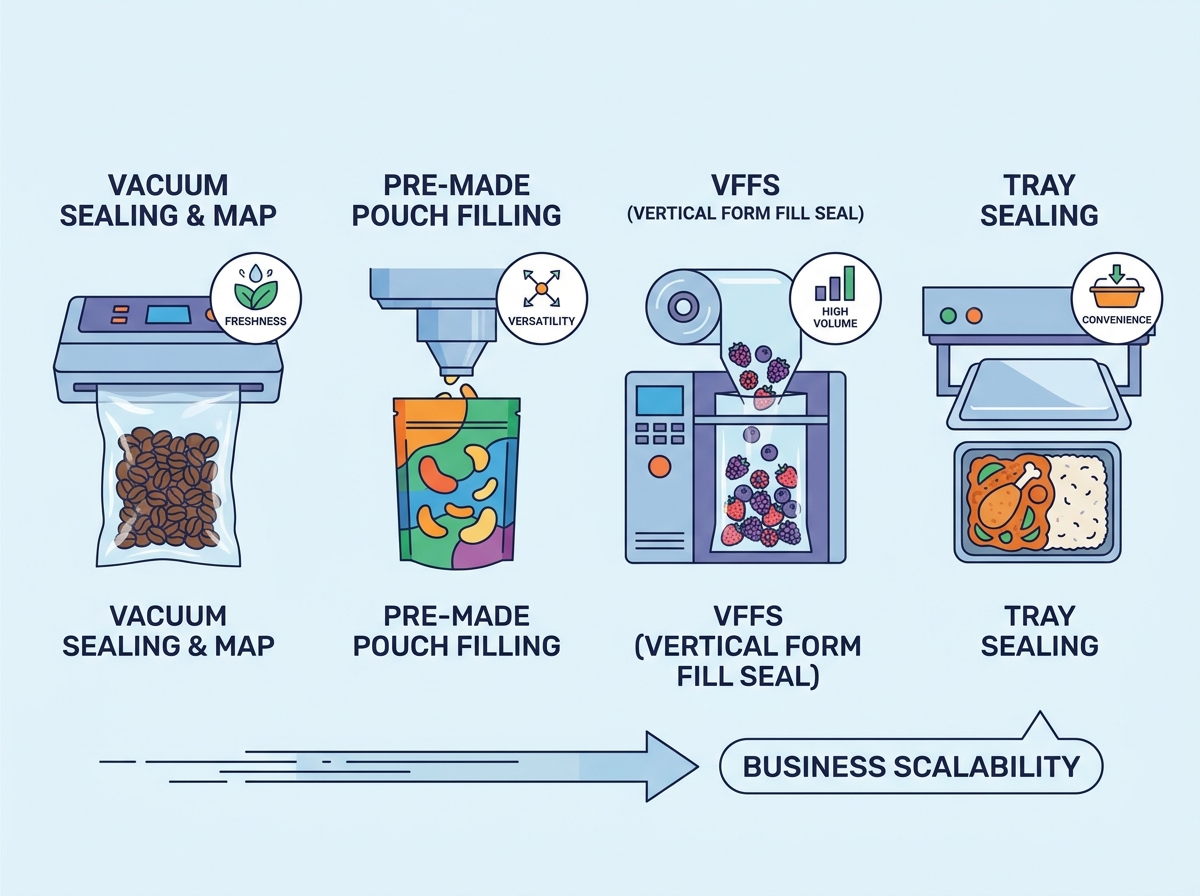
| Vacuum Sealing & Modified Atmosphere Packaging (MAP) | Meats, cheeses, coffee, perishables | Removes ambient oxygen and injects inert gas to extend shelf life. |
| Pre-Made Pouch Fillers | Snacks, granular products, premium items | Automates the filling and sealing of pre-manufactured bags. |
| Vertical Form Fill Seal (VFFS) Machines | High-volume commodities, powders, frozen foods | Forms bags from a film roll, fills, and seals continuously. |
| Tray Sealing Equipment | Convenience foods, ready-to-eat meals, produce | Applies a secure film lid to rigid plastic or eco-trays. |
These specialized systems excel at packaging meats, cheeses, coffee, and perishable goods. Such delicate products require extended shelf life to remain safe and appetizing. The machine functions by removing ambient oxygen from the package entirely. It often injects an inert gas like nitrogen before applying the final seal. This modified atmosphere effectively prevents bacterial growth. It also stops product oxidation, keeping food looking fresh on retail store shelves.
These units are ideal for snacks, granular products, and premium retail items. We often see them used for stand-up pouches and attractive doypacks. The equipment automates the opening, filling, and sealing of pre-manufactured bags. They offer high versatility for businesses juggling multiple product SKUs. You can change packaging formats very quickly. This flexibility prevents extensive downtime when switching from beef jerky to trail mix.
High-volume commodities, powders, and frozen foods benefit greatly from VFFS technology. This robust machine forms bags directly from a continuous roll of flat film. It fills and seals the package in one swift, downward motion. This continuous approach provides excellent economies of scale for large production runs. However, you should expect slightly longer changeover times between different bag sizes. Operators must re-thread the heavy film roll manually during changeovers.
Convenience foods, ready-to-eat meals, and fresh produce rely heavily on tray sealers. The machine applies a secure film lid directly to rigid plastic trays. It also works perfectly for modern eco-friendly cardboard trays. This equipment often integrates seamlessly with the MAP technology mentioned earlier. It keeps delicate products visually appealing while extending their overall retail shelf life.
Evaluating industrial machinery requires looking far beyond basic production speeds. You must scrutinize material quality, facility fit, and overall operational flexibility.
Regulatory compliance remains strictly non-negotiable in the food industry. Ensure all product contact surfaces feature 304 or 316-grade stainless steel construction. These specific alloys meet rigorous FDA, CE, and local health authority standards. Grade 316 contains molybdenum, making it superior for salty or highly acidic foods. Both grades resist corrosion from harsh daily cleaning chemicals. Look closely for IP65 water-resistant ratings on the machine panels. This electrical rating proves essential if your equipment requires frequent, heavy washdowns.
Always measure your available floor space before signing a purchase order. Remember to factor in adequate operational clearance for your production staff. Your new machinery also requires dedicated space for necessary auxiliary equipment. This includes industrial air compressors for pneumatic parts. It also includes large multi-head weighers for accurate product dosing. A cramped production floor creates severe physical safety hazards. It also slows down your daily workflow significantly.
Small businesses often juggle diverse product lines and rotating seasonal offerings. Therefore, evaluate exactly how long it takes to switch bag sizes. Ask the manufacturer directly about tool-less changeover features. Operators should not need heavy wrenches to adjust sealing jaws. Quick changeovers prove critical for maintaining high uptime and overall daily profitability.
Avoid purchasing machines locking you into proprietary films or specialized bags. This dangerous trap limits your negotiating power with material suppliers later. Ensure your equipment works seamlessly with standard, easily sourced packaging materials. Open compatibility keeps your ongoing production costs manageable and highly predictable.
The initial invoice price represents just the baseline of your total investment. You must budget accurately for freight shipping and professional installation services. Factor in the costs of specialized training for your production team. Additionally, prepare a realistic budget for routine preventative maintenance parts. You will regularly need new heating elements and replacement Teflon tape. Planning for these hidden implementation expenses prevents severe cash flow surprises later.
Never assume your current building can support heavy industrial equipment. Verify your facility’s electrical capabilities well in advance. Many commercial packing machines require robust 220V single-phase power. Larger, high-speed units often demand dedicated 3-phase electrical power. Standard commercial or light-industrial spaces frequently lack this heavy-duty infrastructure. Upgrading your electrical panels can add significant time and unexpected expense. Also, confirm you have an adequate compressed air supply. Check both the required CFM (Cubic Feet per Minute) and PSI ratings.
Transitioning to automated equipment demands comprehensive staff retraining. You cannot expect manual operators to master new machinery instantly. Assess the usability of the machine's Programmable Logic Controller (PLC) interface. Examine the touchscreen menus for highly intuitive navigation. Look for clear language options and visual troubleshooting guides. Complex or poorly translated software often leads to costly operational errors. Invest heavily in initial training. A well-trained operator maximizes your Food Packing Machine efficiency and longevity.
Purchasing industrial equipment requires a highly methodical approach. Follow these essential steps to shortlist and select your ideal vendor safely.
Investing in automated packaging equipment fundamentally transforms your business capabilities. It shifts your facility from a chaotic, labor-intensive operation to a highly scalable production model. You can finally meet growing retail demand without constantly hiring seasonal staff.
To move forward successfully, take these highly actionable next steps:
Taking a strategic approach ensures you purchase reliable, efficient, and compliant machinery. Your carefully researched investment will protect your product quality and boost your bottom line.
A: Realistic entry-level costs vary significantly by machine type. Semi-automatic tabletop sealers often start around a few thousand dollars. However, entry-level automated pouch packers typically range from $15,000 to $30,000. We strongly warn against purchasing ultra-cheap imported machines. They frequently lack essential safety compliance certifications and offer terrible after-sales support.
A: Generally, frequent changeovers between liquids and solids prove highly impractical. While the base sealing mechanism might remain the same, the dosing apparatus must change. Liquids require piston fillers, whereas solids need augers or multi-head weighers. Swapping these heavy components takes excessive time and risks severe cross-contamination.
A: Maintenance falls into two distinct categories. You must perform daily cleaning and hygienic washdowns after every shift. Mechanical maintenance usually occurs quarterly. This includes checking pneumatic systems, applying lubrication, and replacing consumable sealing bands. Always follow the manufacturer's specific maintenance schedule to prevent unexpected breakdowns.


