
Views: 0 Author: Site Editor Publish Time: 2026-06-29 Origin: Site


Scaling a brand brings a common operational hurdle for growing manufacturers. Manual bagging and sealing processes inevitably max out at frustratingly low speeds. Most hand-packing lines peak at just four to five bags per minute. When attempting to automate, facility managers hit a rigid physical constraint. Traditional industrial equipment demands massive floor space. Small to mid-sized facilities simply lack the room for sprawling packaging lines.
Fortunately, you can achieve automated, high-yield bagging in highly constrained footprints. Manufacturers now prioritize modular, single-lane, or rotary equipment designs. These innovations maximize output in spaces as small as ten to fifteen square feet. You will learn to assess various machine types and plan critical integrations. We will also examine realistic throughput limits to optimize your production floor.
Space Optimization: Compact rotary machines and tabletop roll-baggers can reduce equipment footprint to just a few square feet while increasing output by 10x over manual labor.
The Single-Lane Advantage: Single-lane packing machines offer the highest flexibility for frequent bag size changeovers without requiring expansive line layouts.
Integration is Key: A small footprint machine must still seamlessly connect with appropriate dosing systems (e.g., augers for powders) and end-of-line solutions like an automatic case packing machine.
ROI Focus: The value of compact automation lies not in chasing maximum industry speeds, but in "walk-away operation" that frees up operator bandwidth.
Business owners often assume manual packing saves physical space. However, a stark labor-to-space paradox exists in most growing facilities. Manual packaging requires several operators working simultaneously. They need tables for hand-opening stand-up pouches. They require staging areas for bulk products. They need additional space for foot-pedal impulse sealers. This fragmented setup often consumes more physical workspace than a single automated unit.
Consider the footprint of three workers packing manually. You must account for their chairs, tables, and walking clearance. An automated system consolidates these steps vertically and horizontally. It condenses the entire bagging process into a dedicated, safe zone.
To understand this bottleneck, we must define the performance benchmark. Human operators typically average between four and ten bags per minute. This rate fluctuates based on worker fatigue and pouch complexity. In contrast, entry-level automated systems comfortably handle 15 to 50 bags per minute. This baseline metric highlights the immediate throughput gap.
You can justify this investment clearly through labor reallocation. One compact machine effectively replaces the output of three to four manual operators. You do not need to eliminate these roles. Instead, you reassign these workers to higher-value tasks like quality control or shipping.
Follow these steps to evaluate your current bottleneck:
Calculate your current manual bagging speed per operator.
Measure the total floor space occupied by manual packing stations.
Compare this required floor space to the footprint of a compact packing machine.
Project the labor hours saved per week by automating the filling process.
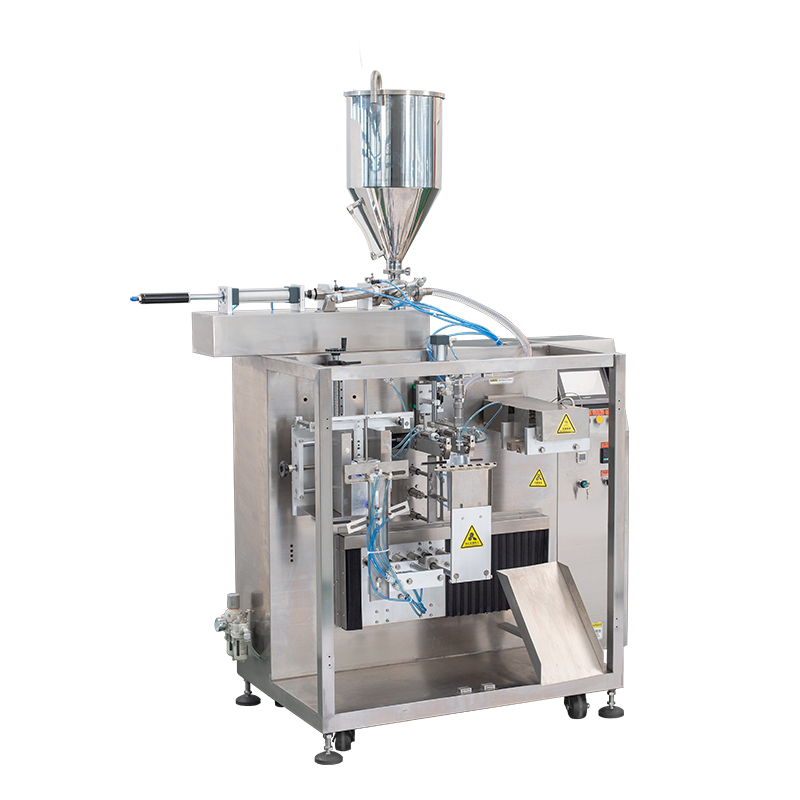
Tabletop rollbaggers provide the perfect solution for extreme space limits. These semi-automatic machines fit on standard workbenches and suit modest budgets. They typically feature continuous band sealing and air-blow bag opening. A continuous band sealer moves the pouch through heated jaws rapidly. This proves much faster than traditional pulse bar sealers.
These units work best for lightweight hardware and e-commerce fulfillment. They handle simple poly bags exceptionally well. Operators simply drop the product into the air-opened bag, and the machine seals it instantly.
Rotary machines deliver the most efficient footprint-to-performance ratio for retail packaging. They excel at handling premium stand-up pouches. The circular layout shrinks the machine's overall length significantly. This design allows full packaging operations in spaces as small as 10 to 15 square feet.
The rotary configuration moves the pouch through circular stations. One station opens the bag, the next fills it, and the final station seals it. This keeps the machine highly condensed. It prevents the need for long, linear conveyors.
Single-lane machines remain the default choice for tight operational spaces. They accommodate varied SKUs easily. If your business requires frequent product changeovers, single-lane systems offer unmatched agility. They avoid the massive downtime associated with multi-lane stick-pack machines.
Multi-lane machines process several bags side-by-side. They offer immense speed but demand enormous floor space. Single-lane systems prioritize flexibility. You can transition from a flat pouch to a gusseted bag quickly without rebuilding the entire line.
Machine Type | Ideal Footprint | Typical Speed (BPM) | Best Application |
|---|---|---|---|
Tabletop Rollbagger | 2 - 4 sq. ft. | 10 - 25 | E-commerce, hardware, poly bags |
Compact Rotary | 10 - 15 sq. ft. | 20 - 50 | Retail stand-up pouches, food items |
Single-Lane Linear | 15 - 25 sq. ft. | 15 - 40 | Frequent SKU changes, varied pouch sizes |
You must prioritize machines featuring toolless changeovers. Look for visual scales and manual adjustment knobs. Rapidly adapting to different bag widths is critical for small teams. For instance, you might need to switch from an 8-inch wide pouch to a 22-inch wide pouch. Doing this without requiring maintenance personnel saves countless hours.
Complex machines require wrenches and specialized tools to adjust grippers. Toolless systems allow standard operators to turn a dial. This empowers your frontline staff and keeps the machine running.
Avoid machines requiring operators to constantly "shingle" bags. Shingling means fanning out bags manually on a conveyor. This forces the operator to stand near the machine constantly. Instead, look for stacked infeeds.
Stacked infeeds allow operators to load hundreds of pouches into a magazine at once. Once loaded, they can walk away. This walk-away operation defines true efficiency. It frees up human bandwidth for monitoring quality or packing boxes.
Secondary labeling stations consume valuable floor space. You can eliminate them by choosing systems featuring integrated print-and-apply technology. These machines feature thermal printing built directly into the bagging frame.
They utilize a "next bag out" printing method. The machine prints the label, opens the bag, and fills it in one fluid motion. This prevents labeling bottlenecks. It ensures barcode accuracy for trace-ability.
Machine downtime kills profitability for growing brands. Look for systems utilizing standardized pneumatics. Some modern compact baggers even utilize 3D-printable wear parts. This reduces downtime dramatically.
When a specialized gripper breaks, waiting weeks for a replacement halts production. Standardized parts eliminate the need to warehouse expensive spare components. You can source them locally or print them on demand.
A compact bagger remains useless if paired with the wrong filler. The filling mechanism sits above the bagging machine. You must match this filler perfectly to your material characteristics.
Powders: Fine products require integrated semi-automatic auger fillers. Auger fillers use a rotating screw to dispense exact volumes. They prevent dust contamination in the seal area. Dusty seals lead to spoiled products and burst bags. Vibratory fillers will fail completely here.
Solids and Granules: You can start with basic linear weighers for coffee beans or candies. Eventually, you can upgrade to mini-multihead weighers on the same machine frame. Multihead weighers calculate optimal weight combinations instantly for high-speed accuracy.
Small Parts: Hardware and plastics require precision optical counting units. Weight-based scales struggle with tiny, irregular items. Optical counters guarantee the exact quantity of items drops into every bag.
Automation growth happens in stages. As your compact bagger pushes past 40 to 50 bags per minute, manual boxing becomes your next critical bottleneck. Your operators will struggle to pack cartons fast enough.
Facility planning should eventually account for adding a compact automatic case packing machine. This equipment seamlessly transitions bagged goods into retail-ready cartons. Modern case packers feature condensed designs. They integrate directly onto the end of your bagging conveyor without expanding the building footprint.
You must set realistic expectations when purchasing compact equipment. Ultra-compact machines trade top-end speed for space savings. A rotary machine occupying ten square feet cannot physically process 150 bags per minute. The laws of physics dictate how fast a bag can open and seal securely.
Do not over-specify machine speed during your research. Chasing 100+ BPM makes no sense if square footage acts as your unyielding constraint. Accept a reliable 30 to 50 BPM pace. This still provides a massive upgrade over manual labor.
Compact machines still demand robust supporting infrastructure. Ensure your operational space can support necessary peripherals. Pneumatic bag grippers require external air compressors. These compressors generate noise and require their own small footprint.
You must also plan for static neutralization devices. Tight environments handling lightweight plastics generate intense static electricity. Without neutralizers, small parts cling to the bag walls. They interfere with the sealing jaws and cause messy failures.
Evaluate the human element carefully. Compact machines often pack many components into a tight chassis. This can make maintenance difficult if designed poorly. The machine must feature a simplified Human-Machine Interface (HMI).
Look for straight-line visibility. A single operator should monitor bag opening, filling, and sealing clearly from one stance. They should not need to walk around a massive footprint to clear a simple jam. Easy access panels ensure daily cleaning happens quickly.
Automating your bagging process in a small facility requires strategic decision-making. Start by calculating your current manual bagging speed. Next, measure your available vertical and horizontal clearance accurately. Finally, select a flexible single-lane or tabletop rotary machine that fits those exact parameters.
Remember that automation in tight spaces acts as an iterative process. You should start with a reliable, compact bagger. As revenue grows, modularly upgrade your dosing systems and integrate end-of-line casing solutions. This phased approach protects your cash flow while steadily increasing throughput.
Take action today by mapping your floor space. Encourage equipment buyers to request footprint layout diagrams and CAD drawings from manufacturers. Always perform a material test with your specific pouches and products before purchasing. This ensures your chosen machine handles your unique packaging flawlessly.
A: Tabletop roll-baggers require only standard desk space, roughly 2 to 4 square feet. Fully automatic rotary pre-made pouch machines condense down to roughly 10 to 15 square feet. This allows high-speed automation in remarkably tight industrial or commercial spaces.
A: Yes, provided the machine features toolless adjustments. Most compact single-lane machines can transition between flat pouches, stand-up zipper pouches, and gusseted bags within minutes. You simply adjust the mechanical dials to accommodate the new bag dimensions.
A: Yes, but the bagging machine must integrate tightly with an auger filler. It must also feature dust extraction or vacuum capabilities to keep the seal area clean. Vibratory fillers will fail in this scenario, as they create airborne dust that ruins bag seals.


