
Views: 0 Author: Site Editor Publish Time: 2026-06-19 Origin: Site


Scaling a candy brand often hits a critical bottleneck. Manual wrapping destroys profit margins. At the same time, packaging bottlenecks limit your total factory output. Relying on hand-packing slows down your entire operation. It cuts directly into your profitability and prevents market expansion.
You must view packaging as the "second R&D" phase of your candy product. The right candy packing machine does more than simply bag sweets. It actively extends shelf life. It prevents moisture degradation during long transit times. It also instantly elevates your brand perception on crowded retail shelves.
Moving from manual processes to fully automated packing requires a strategic approach. Upgrading an existing production line means cutting through vendor marketing fluff. You need to carefully evaluate the mechanical features. These specific internal components determine your true operational return on investment.
Smart Material Handling: Features like vibrating plates or centrifugal feeders are non-negotiable depending on candy stickiness or hardness.
Waste Reduction Tech: "No candy, no packaging" sensors and PID temperature controls prevent empty bags and burned films.
The Speed Caveat: Ultra-high speeds (e.g., 1200 pcs/min) are only viable if your upstream candy dimensions are strictly consistent.
Buyers often rush to review machine specifications before defining their internal baselines. You must establish the business problem first. A thorough internal audit prevents costly equipment mismatches. We recommend working through a structured demand checklist.
Physical Properties of the Product: Determine the exact nature of your candy. Sticky gummies behave very differently than hard mints. Moisture-sensitive honey caramels experience "cold flow" over time. Uniform hard candies can endure aggressive sorting. You must map these traits before selecting a feeding mechanism.
Production Volume (BPM): Calculate your required Bags Per Minute (BPM). Do not just look at your current average output. You must account for peak seasonal demand. A machine running at maximum capacity constantly will wear out faster. Aim for equipment where your peak demand represents 80% of its maximum capacity.
Packaging Hierarchy & Format: Identify your exact packaging layers. Primary packaging involves single-piece wraps like flow wrapping or twist ties. Secondary packaging drops multiple pieces into a larger bag via a Vertical Form Fill Seal (VFFS) setup. Retail-ready packaging often requires specialized stand-up pouches, also known as Doypacks.
Upstream Integration: Assess your existing factory floor. Decide if the new machine needs to sync directly with your current candy depositing line. Modern facilities use unified interfaces to connect forming and packaging. This reduces human error and keeps production moving continuously.
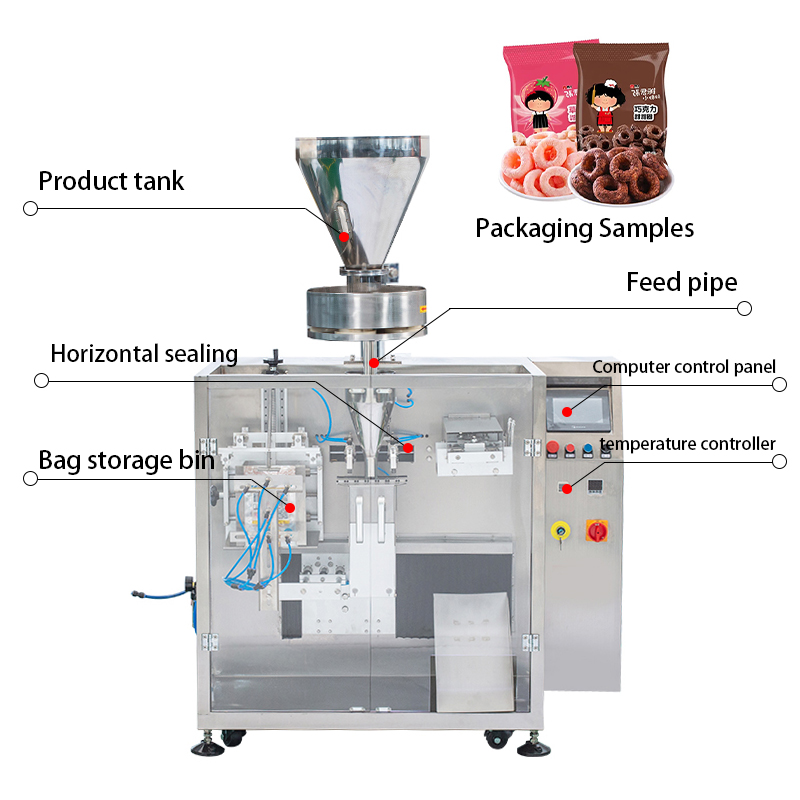
Once you define your baseline needs, you can evaluate specific technical components. You should demand modern engineering standards. Older mechanical designs cost less upfront but fail frequently. Look for these core features to guarantee reliability.
Gravity-fed volumetric systems are largely obsolete for premium candy. Instead, look for multihead weighers utilizing independent suspension load cells. These sensors guarantee weight accuracy down to the fraction of a gram. This precision ensures strict regulatory compliance. It also prevents excessive product giveaway, saving thousands of dollars annually. Independent suspension isolates the weighing buckets from factory floor vibrations.
Film waste quickly drains your operational budget. Ensure the machine features advanced photoelectric eye tracking. It should include empty-bag prevention software. If a feed slot arrives empty, the machine automatically skips the sealing jaw sequence. This "no candy, no pack" logic saves expensive film costs. It drastically reduces your daily reject rates.
Candy packaging materials vary wildly. You might run BOPP, PET, PE, or cold-seal laminates. Each material requires distinct thermal profiles. Proportional-Integral-Derivative (PID) controllers provide precise, adaptive heat control. They maintain exact sealing temperatures despite environmental changes. This prevents burn-throughs on thin films. It also ensures airtight seals on thick, high-barrier laminates.
Sanitation requires serious attention. All product contact parts must be 304 or 316 stainless steel. Advanced machines take this a step further. They include Clean-in-Place (CIP) online cleaning systems. CIP technology uses targeted water, detergents, and heat to sanitize dead corners automatically. Operators do not need to dismantle the machine. This drastically reduces changeover time between different candy flavors.
Component Function | Legacy Technology | Modern Requirement | Operational Benefit |
|---|---|---|---|
Product Weighing | Volumetric Gravity Feed | Multihead Independent Load Cells | Eliminates product giveaway; high accuracy. |
Sealing Temperature | Basic On/Off Thermostats | PID Adaptive Controllers | Prevents melted film; seals complex laminates. |
Empty Slot Detection | Continuous Blind Sealing | Photoelectric "No Pack" Sensors | Saves material; prevents empty bags. |
Sanitation Process | Manual Teardown & Wash | Automated Clean-in-Place (CIP) | Cuts downtime; ensures food safety. |
A generic machine setup will fail if applied to complex candies. You must match mechanical add-ons to specific physical traits. Common candy handling failures usually stem from mismatched feeding mechanisms.
For Gummies (Stickiness & Jamming): Gummies contain pectins and gelatins. These ingredients act like glue under high factory humidity. Standard hoppers will clog constantly. Look for VFFS machines equipped with dimpled steel surfaces. Dimpling reduces the surface contact area. You also need vibrating plates or vibrating bowl feeders. Constant micro-vibrations prevent sticky candies from clumping before they reach the weighing buckets.
For Hard Candies (High-Speed Sorting): Hard mints and lozenges require high-speed, single-piece packaging. Look for horizontal flow wrappers utilizing centrifugal feeding devices. These machines spin a central disc. They use centrifugal force to rapidly align uniform hard candies into the packaging channel. This method safely sorts products without chipping or cracking the sugar shells.
For Caramels & Taffy (Cold Flow & Moisture): Caramels present a unique physics problem known as "cold flow." Over time, they slowly deform and spread. They also absorb moisture rapidly. Double-twist wrapping remains the industry gold standard for artisanal appearance. However, twist machines require high upfront capital. A horizontal flow wrapper using specialized film offers a highly viable alternative. Utilizing a metallized VMPET film provides a high moisture barrier. This is a budget-friendly way to prevent moisture absorption while protecting the candy's shape.
Vendors often boast about maximum operating speeds. You must evaluate these performance claims with deep skepticism. Pushing equipment to its theoretical limit usually destroys quality control.
Consider the "1200 Pieces/Minute" reality check. Some vendors advertise ultra-high-speed horizontal flow wrapping. Running at absolute maximum capacity requires strictly consistent candy dimensions. Your upstream forming line must output products with near-zero tolerance for error. If your candy varies in size, extreme speed becomes a liability.
Dimensional variance creates severe risks at high speeds. Common issues include:
Catastrophic Jamming: A candy piece 1mm too wide will snag the feed channel, causing a pile-up.
Crushed Product: If timing is slightly off, the sealing jaws will crush the candy instead of the film.
High Reject Rates: Micro-stops and misalignments lead to poorly sealed bags that fail quality control.
To mitigate these risks, prioritize advanced motor control. Avoid older double-inverter technologies. Recommend machines featuring multi-axis servo drives. Servo motors allow precise digital control over the feeding belt, the film pull, and the sealing jaws. They allow operators to start at low speeds. Your team can then scale up safely as the production line stabilizes.
Looking past the initial equipment capability is crucial. You must shortlist vendors based on long-term operational viability. A machine is only valuable if your team can keep it running daily.
Assess the Human-Machine Interface (HMI) and overall automation level. Look for equipment with networked PLC controllers. Modern HMIs store historical shift data and recipe presets. Operators simply tap a screen to switch from packing soft gummies to hard mints. This lowers the technical ceiling on your factory floor. It drastically reduces your reliance on highly skilled, hard-to-find technicians.
Spare parts accessibility dictates your long-term downtime. A machine with a low sticker price often utilizes proprietary, hard-to-source parts. If a specific sensor fails, you might wait weeks for international shipping. Prioritize machines built with standard, locally accessible pneumatics and electronics. Off-the-shelf components from major global brands keep you running smoothly.
Finally, scrutinize the safety features. Basic emergency stops are not enough. Ensure the presence of shutdown position protection. If the machine stops unexpectedly, the heated sealing jaws must automatically open. This prevents the jaws from resting on stationary film, avoiding melted plastic, burned candy, or factory fires.
Selecting the right candy packaging equipment involves a careful balancing act. You must align your product's unique physical demands with realistic output goals. Start by establishing an internal demand checklist. Match specific machine additions to your candy type, like vibrating plates for sticky gummies. Be skeptical of maximum speed claims unless your upstream production is flawlessly consistent. Finally, prioritize usability and standard components to ensure lasting reliability.
Before you finalize any purchase, take protective steps. Always request a Factory Acceptance Test (FAT). Send bulk product samples to the manufacturer. Have them test your specific candy and film on their actual equipment. You must physically verify that the machine handles your recipe without jamming or seal failures.
Ready to upgrade your production floor? Contact a packaging sales engineer today to request a comprehensive line assessment. They will help you match your candy's exact physical properties to the perfect automated solution.
A: Vertical Form Fill Seal (VFFS) machines bag bulk candy using gravity. They pull film into a tube, fill it with multiple pieces from above, and seal the ends. Flow wrappers operate horizontally at high speeds. They wrap individual pieces of candy in a continuous film web, typically used for hard candies and mints.
A: Yes. Modern machines equipped with PID temperature controllers and adjustable forming tubes handle various films smoothly. You can easily switch between BOPP, CPP, and complex laminates. However, traditional paper or foil twist-wrapping requires completely dedicated mechanical machinery.
A: Jamming usually results from a mismatch between candy texture and machine design. Environmental humidity causes sugar to sweat and stick. If you pack gummies or soft caramels, you need dimpled surfaces and vibrating feeders. Improper sizing for the feed channel also causes physical blockages.
A: Entry-level horizontal flow wrappers or mini-Doypack machines provide the fastest return on investment. They are significantly cheaper and easier to maintain than complex cross-twist or double-twist wrappers. They offer professional retail presentation while keeping initial capital expenditures low.


